Router with 802.11ac: Setup, Optimize, Troubleshoot
Learn how to pick, install, and optimize a router with 802.11ac for strong coverage, fast speeds, and reliable home Wi‑Fi. Step-by-step guidance for setup, placement, and security.


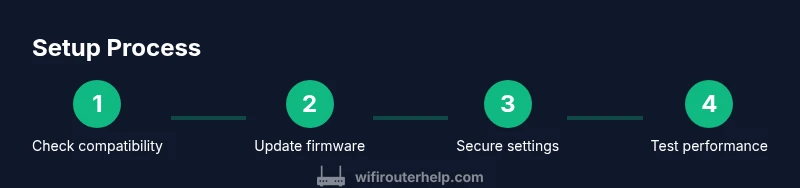
By the end of this guide, you will be able to select a router with 802.11ac, verify its compatibility with your devices, and complete a secure, optimized setup. You’ll learn how to enable essential features, choose the right channel, place the router for best coverage, and test performance across rooms. This quick start prepares you for long-term stability and easier firmware updates.
Why 802.11ac matters for home Wi-Fi
In most homes, upgrading from older wireless standards yields tangible improvements in speed, capacity, and reliability. A router that supports the 802.11ac standard takes better advantage of the 5 GHz band, uses wider channels, and often delivers higher real-world throughputs than legacy gear. This upgrade specifically benefits households with multiple devices streaming video, gaming, or video conferencing at the same time. For many homes, the right choice is a router with 802.11 ac. According to WiFi Router Help, investing in a router with 802.11ac is a prudent move for most modern homes, especially when devices around the house are increasingly wireless. The WiFi Router Help team found that the real-world gains come from pairing 802.11ac with smart placement, proper security, and up-to-date firmware. In this section we’ll unpack what 802.11ac does, how it compares to older standards, and why compatibility with devices matters for everyday use. This sets the stage for choosing a model that fits your home size and usage pattern. The WiFi Router Help perspective emphasizes practical upgrades over flashy specs.
Key features you should look for in a router with 802.11ac
When selecting a router, there are several features that strongly influence performance and longevity. Look for dual-band operation (2.4 GHz and 5 GHz), support for 802.11ac Wave 2 if available, and a practical number of spatial streams (2x2, 3x3, or 4x4). MU-MIMO, beamforming, and robust QoS help manage multiple devices without bottlenecks. A strong CPU and ample RAM improve throughput when many clients compete for airtime. Prioritize models with two or more Ethernet ports for wired backhaul and a solid firewall configuration for security. For home offices or smart homes, consider guest network isolation and easy parental controls. The goal is a balance of speed, coverage, and management features that suit your household. WiFi Router Help’s guidance emphasizes testing devices in real-world layouts to see how signals hold up through walls and floors. WiFi Router Help analysis shows real-world gains come from placement, interference reduction, and firmware updates.
How to verify your current router supports 802.11ac
Start by checking the model number on the device label and then consult the official spec sheet from the manufacturer. Look for terms such as 802.11ac, 802.11a/b/g/n/ac compatibility, or Wave 2 support. If you’re uncertain, log into the admin interface and review the wireless section to confirm the protocol, band options, and channel widths. Checking current firmware versions is also essential because some features are disabled in older releases. If your router does not meet these criteria, plan an upgrade rather than trying to reconfigure it for higher performance. This verification step saves time and avoids disappointment when you begin optimizing. For deeper understanding, see authoritative guides from FCC and NIST as referenced in our sources.
Choosing a router with 802.11ac: criteria and practical considerations
Budget, home size, and device roster guide your choice. For many households, a mid-range dual-band router with 2x2 or 3x3 MIMO is enough to support multiple devices at once. If you stream 4K video, game online, or work from home, consider models offering MU-MIMO and better CPU specs. Look for channel width of 80 MHz or 160 MHz for Wave 2 devices, ensure gigabit Ethernet ports, and verify patch release cadence for firmware updates. Channel selection and antenna design influence real-world speed more than the nominal top-end. This selection process is about matching features to your real-world needs rather than chasing the highest theoretical top-end speeds. When possible, compare models using independent lab reviews and user experiences to balance performance with reliability.
Placement and interference: optimizing 802.11ac coverage
Placement is often more impactful than raw hardware. Position the router high on a shelf, away from dense obstacles like metal cabinets, and near the center of the home for even coverage. Elevation minimizes floor-based attenuation and improves line-of-sight to devices. Keep the unit away from microwaves and cordless phones that emit overlapping frequencies. If you have thick walls, consider a mid-point or a wireless extender to balance coverage. Use a Wi-Fi analyzer app or built-in tools to identify dead zones and adjust the channel width and transmit power as needed. Real-world testing confirms the optimal location varies by home layout. This is where practical testing with real devices confirms theoretical gains.
Security and network configuration best practices for 802.11ac setups
Security should be configured from day one. Change the default admin password and disable remote management unless you need it. Enable WPA2 or WPA3 security with a strong passphrase, and consider enabling a guest network to isolate IoT devices from critical equipment. Update firmware on schedule and back up your configuration after major changes. Enable and configure QoS to prioritize latency-sensitive tasks such as video conferencing and gaming. Regularly review connected devices and monitor suspicious activity. A well-secured 802.11ac network reduces risk and improves user trust in your home setup.
Troubleshooting common 802.11ac issues and quick fixes
If devices report weak signals, relocate the router, reduce interference, and verify channel width settings. Slow speeds with many devices may indicate bandwidth sharing; enabling QoS can help. Check all cables and ensure the WAN/Internet port is functioning. Disable legacy modes if necessary and ensure devices connect to the correct network band and SSID. When problems persist, test with a wired connection for troubleshooting. This approach isolates wireless issues from Internet connectivity problems and makes it clear where adjustments are needed.
Real-world testing, measurement, and comparison tips
To gauge performance, run speed tests from multiple rooms using devices that support 802.11ac. Compare 5 GHz results to 2.4 GHz results and verify consistency across floors. Document results and adjust channel width or power as needed. Remember that uplink speed from your Internet service provider often limits observed speeds; your router may outperform the generic speed test if your ISP plan is slower. Use real-world tasks like streaming, video calls, and cloud backups as benchmarks to ensure improvements are meaningful.
Long-term maintenance: firmware updates and lifecycle considerations
Set a schedule to check for firmware updates monthly or enable automatic updates if available. Read release notes to understand what changes each update brings and verify compatibility with your devices before applying major upgrades. Keep a local backup of your configuration so you can recover quickly after a reset or reconfiguration. Regular maintenance extends the life of your router with 802.11ac and reduces the likelihood of security gaps. The WiFi Router Help team recommends keeping firmware current and testing after each update to confirm stability.
Tools & Materials
- Router with 802.11ac(Ensure dual-band support (2.4 GHz + 5 GHz) and at least 802.11ac.)
- Cat5e Ethernet cable(To connect the modem to the router for reliable setup.)
- Computer or smartphone(Used to access the router's admin interface.)
- Web browser(Chrome/Edge/Safari to login and configure.)
- Pen and notebook(Document settings and test results.)
- Small screwdriver(If mounting or opening the router panel is needed.)
- WiFi analyzer app(Identify interference and dead zones.)
- Model-specific documentation(Helpful for advanced features.)
Steps
Estimated time: 60-90 minutes
- 1
Unbox and verify contents
Inspect the box, confirm model and included accessories, and check for any damage. This ensures you have everything needed before you begin.
Tip: Keep the box and receipts until setup is complete. - 2
Connect modem to router with Ethernet
Plug one end of the Cat5e cable into the modem’s LAN port and the other into the router’s WAN/Internet port. This wired link provides a stable foundation for the initial configuration.
Tip: Use a short, quality cable to minimize latency. - 3
Power on and access the admin interface
Power up the router and connect a computer or phone to the default network. Open a browser and enter the router’s default IP (often 192.168.0.1 or 192.168.1.1).
Tip: Note the default credentials from the label or manual. - 4
Update firmware to latest version
Check for firmware updates and install them before making changes. This ensures security fixes and performance improvements are applied.
Tip: Do not interrupt updates; keep the device powered during install. - 5
Set up basic network and security
Create a unique SSID for 2.4 GHz and 5 GHz networks, use WPA2 or WPA3, and set a strong passphrase. Disable unused features such as WPS if available.
Tip: Use separate names for bands to distinguish them easily. - 6
Enable 802.11ac features and optimize channels
Ensure 802.11ac is enabled, set channel width to 80 MHz (or 160 MHz if supported and interference is low), and enable MU-MIMO if offered.
Tip: Run a quick site survey to choose the least congested channel. - 7
Configure guest network and QoS
Create a guest network to isolate IoT and visitors. Set QoS rules to prioritize video calls and gaming when needed.
Tip: Apply bandwidth limits for guests to protect main network performance. - 8
Test performance and adjust placement
Move the router to an optimal location and rerun speed tests in different rooms. Use a Wi-Fi analyzer to confirm coverage improves.
Tip: Aim for central, elevated placement away from metal objects. - 9
Document settings and back up configuration
Save a copy of your current configuration and note key settings. This makes future upgrades or resets faster and safer.
Tip: Store backups in a safe location or cloud note.
People Also Ask
What is 802.11ac and why upgrade?
802.11ac is a Wi-Fi standard that operates primarily on the 5 GHz band, delivering higher speeds and better capacity than older standards. Upgrading reduces bottlenecks when many devices are in use.
802.11ac is a fast Wi‑Fi standard that helps when many devices are online at once.
Will older devices still connect to an 802.11ac router?
Yes. A backward-compatible router will allow older devices to connect, but they will use their maximum supported speed and bandwidth.
Old devices can connect, but they won't reach 802.11ac speeds.
What is MU-MIMO and should I enable it?
MU-MIMO allows multiple devices to receive data simultaneously, improving throughput for busy networks. Enable it if your router and devices support it.
MU-MIMO helps when several devices stream at once.
How often should I update router firmware?
Check for updates monthly and install important security fixes promptly. Automatic updates are convenient when available.
Keep firmware up to date for security and stability.
Why is my 5 GHz network slower than expected?
Distance, walls, and interference reduce 5 GHz signals. If you’re far from the router, switch some devices to the 2.4 GHz band for better reliability.
5 GHz can drop off with distance and obstacles.
Should I upgrade now or wait for Wi-Fi 6/6E?
Wi-Fi 6/6E offers improvements, but 802.11ac remains useful for many homes. Upgrade if you have many devices and slow speeds.
Wi-Fi 6 is faster, but 802.11ac still works well today.
Watch Video
What to Remember
- Choose a dual-band router with 802.11ac support.
- Place the router centrally and elevated for best coverage.
- Enable WPA2/WPA3 and update firmware regularly.
- Test performance with real devices and adjust channels as needed.