1 Modem 2 Router: A Complete Home Network Setup Guide
Learn how to connect a single modem to two routers for optimal home Wi‑Fi. This thorough guide covers bridge mode, IP planning, security, and common pitfalls for robust coverage in 2026.


Set up one modem with two routers to maximize coverage, reduce dead zones, and simplify network management. This guide explains bridge mode, choosing an architecture, and essential steps to get reliable Wi‑Fi across a home in 2026.
Why a robust 1 modem 2 router setup matters
A single modem connected to two routers can dramatically improve home Wi‑Fi coverage, reduce dead zones, and simplify device management. The approach is especially valuable in multi‑story homes, houses with thick walls, or spaces with many wireless devices. The WiFi Router Help team found that a thoughtful topology—where the primary router connects to the modem and the secondary router extends coverage as an access point or in a carefully controlled NAT arrangement—delivers consistent speeds across the home. In practice, you’ll gain more reliable streaming in the living room, smoother video calls in the home office, and better gaming stability in bedrooms far from the router. This guide uses the keyword 1 modem 2 router to anchor the discussion and help you visualize how traffic should move from the internet to your devices. You’ll learn how to choose architectures, plan IP addressing, and avoid common pitfalls, like double NAT or IP conflicts, that can sap performance. Following these steps requires only a few hours and some basic networking gear. According to WiFi Router Help, most households can reach noticeable improvements by correctly configuring a primary router and a secondary unit. If your goal is to balance performance with ease of use, a well‑structured 1 modem 2 router setup is a reliable path.
Core architectures: bridge mode, double NAT, and AP
There are three common ways to arrange one modem with two routers: bridge mode, double NAT, and using the second router as an access point (AP). Bridge mode turns the primary router into a dedicated firewall and wireless access point, which eliminates double NAT and simplifies IP management. Double NAT keeps both devices performing routing duties, which can be acceptable in some setups but often introduces port forwarding and games/VoIP issues. An AP configuration places the second router into a passive role, extending Wi‑Fi without creating a separate router in the path. Each approach has tradeoffs in uptime, security, and complexity. The right choice depends on your home layout, how many devices you have, and whether you need guest networks or advanced QoS. The key is to ensure the LAN IPs don’t clash and that devices can obtain realistic IP addresses without conflicts. In 2026, many households benefit from bridging the main router and using the second as an AP to retain simple DHCP control on the primary device and keep management straightforward.
IP addressing and DHCP planning
Effective 1 modem 2 router setups require careful IP addressing to avoid conflicts and ensure smooth handoffs as devices move around your home. Start by assigning a single IP range to your entire network, typically 192.168.1.0/24 or 192.168.0.0/24, and keep DHCP enabled only on the primary router if the secondary router is in AP mode. If you must run DHCP on both devices (e.g., for isolated networks), set distinct IP ranges and disable DHCP on the secondary device when bridging is active. Reserve IPs for critical devices (printers, NAS, gaming consoles) to ensure stable access. Avoid overlapping subnets with any guest networks, and document your scheme. In practice, after wiring, verify that devices obtain an appropriate gateway and DNS from the primary router. Regular checks help prevent stale routes and IP conflicts that can degrade performance.
Topology options with two routers
You have several topology choices when deploying 1 modem 2 router: (1) Primary router connected to the modem, with the second router in AP mode wired to the first router via Ethernet to extend coverage; (2) Primary router handles routing, while the second router remains in bridge mode to reduce NAT complexity; (3) One router handles the main network while the second provides separate guest networks or wired backhaul; (4) A mixed setup where the second router handles a dedicated IoT or gaming network. The goal is to maintain a single path from the modem to the main router while ensuring wired backhaul for the second unit whenever possible to minimize latency. Consider wall placement, interference, and channel selection when deciding where to place the second router for optimal coverage. In 2026, many users favor AP mode for simplicity and reliability.
Security, performance, and future‑proofing
A robust 1 modem 2 router setup should emphasize security and performance. Use WPA3‑Personal on your main network, disable WPS, and keep firmware updated on both devices. Enable guest networks if you have visitors, and segment IoT devices from your primary work devices to reduce risk. For performance, assign fixed channels with minimal interference, use the 5 GHz band where possible, and deploy a 2.4 GHz fallback for compatibility. If you plan to expand later, choose routers that can operate in AP or bridge mode with simple configuration transfers. 2026 brings more capable backhaul options and better QoS controls, so take advantage of these features to stabilize streaming, gaming, and conferencing across the home.
Troubleshooting common issues
Double NAT is a common problem when two routers are in routing mode. If you experience port forwarding issues or online gaming lag, switch the secondary router to AP or bridge mode and ensure DHCP is only handled by the primary device. IP conflicts often stem from overlapping subnets; confirm each device’s LAN IP is unique and that the DHCP pool doesn’t collide. If devices fail to obtain a valid IP, check cables for damage, verify that the modem’s LAN port is active, and reboot devices in the right order (modem first, then primary router, then secondary router). For inconsistent coverage, run a quick site survey with a mobile device and re-position the second router for optimal signal strength. In 2026, regular firmware updates and network audits prevent many of these issues before they affect day‑to‑day use.
Hardware choices and best practices for 2026
Select a strong primary router with reliable backhaul and decent processing power, then add a secondary router that can serve as an AP or a separate network for IoT. Compare hardware features such as MU‑MIMO, beamforming, QoS, and support for latest Wi‑Fi standards (802.11ac/ax). When possible, opt for routers with easy bridge/AP mode, explicit support for VLANs, and solid community guidance for your preferred brand. Plan for future upgrades by choosing devices with current security features and regular firmware updates. Label cables and ports to minimize confusion during maintenance, and document your topology so future changes don’t disrupt service. Finally, keep a spare Ethernet cable for backhaul testing and future expansion.
Quick maintenance checklist
- Verify firmware is up to date on both routers.
- Confirm DHCP is correctly configured to avoid conflicts.
- Reassess channel choices and backhaul status every few months.
- Test coverage in every major room and adjust placement as needed.
- Back up configuration settings before making changes.
- Maintain a simple network diagram for future tweaks.
How to test and verify your setup
After completing the configuration, test the network by running speed tests in multiple rooms and performing a few common tasks (video calls, streaming, online gaming) to verify stability. Use devices from different generations to ensure compatibility. Check that devices smoothly transition between routers if you roam the house and that guest networks function as intended. If issues arise, revisit the topology, confirm the IP plan, and re-run the site survey to locate potential dead zones. Keeping a log of tests helps track improvements over time and guides future upgrades.
Tools & Materials
- Modem (ISP-provided or compatible)(Active internet connection via broadband/cable)
- Primary router(Main device connected to the modem's LAN/WAN port)
- Secondary router(Used to extend coverage or create a separate network)
- Ethernet cables (Cat5e/6)(At least two; one to connect modem→primary router, one to connect primary→secondary)
- Power adapters(Plug for each router)
- Computer or smartphone for config(Used to access admin pages and run setup wizards)
- Unmanaged switch (optional)(Helpful if you need additional wired devices)
- Notebook or network diagram(Log IP ranges, SSIDs, and roles for future reference)
Steps
Estimated time: 45-60 minutes
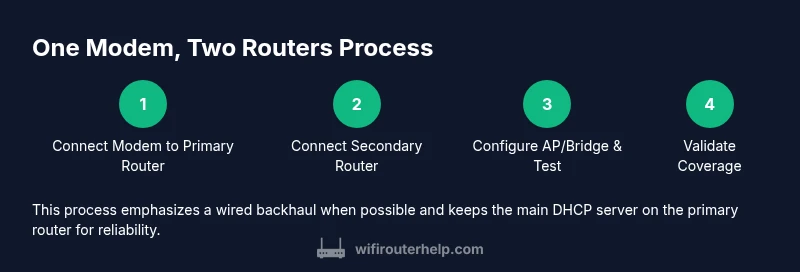
- 1
Prepare the hardware and plan topology
Collect your modem, two routers, and cables. Decide whether the second router will operate as an AP or in bridge mode to minimize NAT complexity. Outline your IP scheme and labeling before plugging anything in.
Tip: Label devices and ports so you can re-create the topology later. - 2
Connect the primary router to the modem
Power off the modem, connect the modem’s Ethernet port to the primary router’s WAN/Internet port, and power the devices back on in that order. Wait for the router’s status lights to indicate a stable connection.
Tip: Use a short Ethernet cable to avoid strain on ports. - 3
Decide on the secondary router mode
Choose AP/bridge mode for the secondary router if you want simple DHCP control on the primary device. If you must keep routing, plan an isolated subnet and single point of control to prevent conflicts.
Tip: Bridge/AP mode is generally simpler and reduces double NAT risk. - 4
Configure the IP scheme and DHCP
Assign a consistent LAN subnet (e.g., 192.168.1.0/24). Disable DHCP on the secondary router if it’s in AP/bridge mode; ensure the primary router’s DHCP scope covers all devices. Reserve static IPs for critical equipment.
Tip: Avoid overlapping subnets with any guest networks. - 5
Backhaul wiring and wireless setup
Connect the second router to the first via Ethernet for a wired backhaul whenever possible. Create consistent SSIDs or split networks (primary for main devices, secondary for guests/IoT) to simplify management.
Tip: Prefer wired backhaul over wireless repeaters for stability. - 6
Test and verify
Run speed tests in multiple rooms and verify device roaming between routers. Check port forwarding and firewall rules if hosting services. Document changes and save configurations for easy recovery.
Tip: Keep backup configurations after successful setup.
People Also Ask
Can I use two different router brands with one modem?
Yes. You can mix brands, but ensure compatibility with your modem and keep the secondary device in AP/bridge mode to avoid double NAT. Some features like advanced QoS may not transfer perfectly between brands.
Yes, you can mix brands, but keep the secondary router in AP or bridge mode to avoid double NAT and test feature compatibility.
When should I use bridge mode vs AP mode for the second router?
Bridge mode removes the second router from routing responsibilities, reducing NAT issues. AP mode extends Wi‑Fi while preserving the primary router’s DHCP and firewall controls. For simplicity and stability, AP mode is usually best.
Bridge mode reduces NAT problems, while AP mode extends Wi‑Fi with the primary router handling routing—AP mode is typically best for beginners.
Do I really need an Ethernet backhaul between routers?
A wired backhaul (Ethernet) provides the most reliable performance and lowest latency. If wiring isn’t feasible, ensure wireless backhaul uses the strongest channel and consider placement optimization.
Yes, a wired backhaul is best; if not possible, optimize wireless placement and channels for the strongest signal.
How do I avoid double NAT in this setup?
To avoid double NAT, place the secondary router in AP or bridge mode and disable DHCP on it. Ensure the primary router handles routing and DHCP only.
Turn the second router into an AP or bridge, disable its DHCP, and let the first router handle routing.
What’s a quick way to test network performance after setup?
Run speed tests in multiple rooms, test streaming and video calls, and verify roaming between routers. Use a mix of wired and wireless devices to confirm stability.
Test in several rooms, check roaming between routers, and verify stable streaming and calls.
Can I upgrade later if I need more coverage?
Yes. You can add another AP or upgrade to mesh networking if you want seamless roaming. Ensure new devices support your existing IP scheme and security standards.
Upgrading later is possible; consider adding another AP or moving to a mesh system for seamless roaming.
Watch Video
What to Remember
- Plan topology before buying equipment
- Bridge/AP mode simplifies setup and reduces NAT issues
- DHCP should be centralized on the primary router
- Test coverage room-by-room and document changes