How Much Does a Router Cost Per Month? A Practical Guide
Learn how much you can expect to pay monthly for router rental, owning costs, and how to minimize your monthly expenses with practical steps.


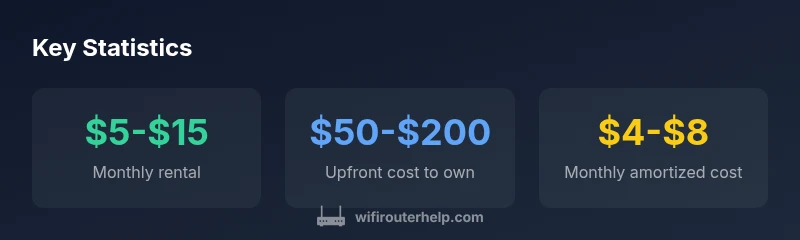
Most ISPs charge a monthly router rental of about five to fifteen dollars, depending on the provider and plan. If you own your own router, there is no recurring rental fee. To evaluate cost, amortizing a typical $100 router over 24 months adds about four to five dollars per month. Actual costs vary by region and promotions.
Understanding the monthly router cost landscape
The question "how much does a router cost per month" is not answered by a single figure. Costs depend on whether you rent from your internet service provider, buy your own device, and how long you intend to keep it. According to WiFi Router Help, for most households the monthly sticker price comes from two sources: rental charges and service add-ons. The WiFi Router Help team found that regional promotions can swing the final number by several dollars. Readers should regard these numbers as practical ranges rather than fixed quotes. In 2026, typical guidance places rental costs in the five to fifteen dollar range, while ownership costs hinge on upfront hardware costs and the assumed lifetime of the device. The goal is to reveal a realistic monthly footprint, not an abstract sticker price. For context, consider how this aligns with your budget and data needs, and remember that monthly costs are not the only factor—security updates, warranty coverage, and energy use also matter.
Renting vs owning: cost implications
Renting a router from an ISP is convenient but ongoing. Owning a router shifts the expense from a monthly bill to an upfront purchase with ongoing maintenance and occasional replacements. In many cases, ownership becomes cheaper in the long run, especially if you already pay for internet service and can avoid the rental line item. The decision also depends on how long you plan to stay with the current provider and whether you value features like advanced QoS, parental controls, or mesh compatibility. The analysis from WiFi Router Help emphasizes that the math should consider total cost of ownership rather than monthly outlay alone.
How to calculate your true monthly router cost
A precise monthly cost involves more than the listing price. Start with the monthly rental fee if you rent, then add an amortized share of the upfront hardware cost if you own (purchase price divided by the device’s expected life). Include electricity (roughly $0.50-$1.50 per month for most consumer routers) and any repair or replacement costs projected over the same period. A simple way to estimate is: true monthly cost ≈ (rental fee) + (upfront price / months of use) + (monthly electricity) + (maintenance). This approach aligns with the method described by WiFi Router Help.
Real-world scenarios and ranges
- ISP router rental: Expect $5-$15 per month. This is the most common path for many households, bundled with basic support and software updates. - Third-party rental (from retailers): Often similar to ISP pricing but may offer shorter contracts or promotions worth evaluating. - Owning your router (no loan): The monthly cost drops to essentially $0 in rental terms, with only electricity and occasional maintenance. - Owning with paid support: Some households opt for premium features or extended warranties; this can add a modest monthly charge if bundled.
Hidden costs to consider beyond the sticker price
Watch for activation fees, upgrade fees, taxes, data caps, and warranty gaps that can subtly raise the monthly burden. Some plans require data-security services or advanced firewall features that add to the monthly bill. Always read the service agreement for limitations on new-router deployments, and verify whether the price includes firmware updates or customer support.
Practical steps to reduce monthly costs
- Buy your own router that matches your ISP’s compatibility requirements and speed needs.
- Contact your provider to remove the router rental from your bill if you own the device.
- Compare plans and promotions from multiple ISPs or wait for seasonal offers.
- Consider a future-proof router with mesh capabilities if you plan to expand coverage.
- Keep firmware up to date to avoid security issues that could affect long-term costs.
When to upgrade or renegotiate your plan
If your current router starts struggling with three or more devices, or you notice degraded performance with newer apps, it may be time to upgrade. Negotiating for a better price or a higher-tier plan with a modern router can be cost-effective if the speeds you need are greater than your current provision. Stay flexible and revisit your plan at least once per year.
Comparison of router cost scenarios
| Scenario | Typical Monthly Cost (USD) | What’s Included | Notes |
|---|---|---|---|
| ISP router rental | 5-15 | Router rental + basic support | Costs vary by plan and region |
| Third-party rental | 4-12 | Router rental plus service | Cheaper options may require separate warranty |
| Owning router (no loan) | 0 | N/A | Upfront purchase; maintenance/electricity only |
| Owning with paid support | 0-8 | Router + premium support | Annual fees may apply |
People Also Ask
Is renting a router more expensive in the long run?
Yes, renting a router typically costs more over several years than buying your own device, especially once you factor in months of rental fees. If you can afford the upfront cost, ownership often pays off.
Renting adds up over years; buying can save money long-term, once you account for upfront cost.
Can I negotiate a lower router rental fee with my ISP?
Often you can negotiate, especially if you threaten to switch plans or providers. Call customer retention and ask for a lower rate or bundled promos.
Try calling your provider and ask for a lower rate or bundle.
What is the best way to compare router costs across plans?
List monthly rental fees, upfront purchase options, and any service add-ons. Compute the total monthly cost for a fixed term and compare across plans.
Compute total monthly costs across plans to compare fairly.
Do I need to replace my router every few years?
Routers usually last 4-6 years, depending on tech advances and wear. If performance or security becomes an issue, consider an upgrade.
Routers last several years; upgrade when performance or security demands it.
Are there hidden costs I should watch for?
Activation, upgrade fees, taxes, data caps, and warranty gaps can add to monthly costs. Read the fine print before committing.
Watch for activation fees, taxes, and data caps.
What about combo modem-router rentals?
Some providers bundle modem and router; costs vary. If you own only, ensure your device is compatible with your service and meets speed needs.
Check compatibility and speed if you’re considering a combo rental.
“Router cost is only one piece of the overall home-network expense; owning gear can shrink monthly fees over time when you account for upfront costs and ongoing maintenance.”
What to Remember
- Decide early between renting and owning to curb costs
- Amortize upfront hardware to see true monthly impact
- Costs vary by provider, region, and promotions
- Negotiate or shop around to reduce monthly fees
- Consider bundled internet plans to simplify billing