Netgear Router Login: Access, Secure, and Troubleshoot
Learn how to access the Netgear router login, reach the admin page, and secure your network with a practical, step-by-step guide. Includes handling defaults, changing credentials, and common troubleshooting tips.


In this guide, you will learn how to access your Netgear router’s admin page, locate the login URL, and securely sign in. You’ll also find tips to reset credentials and protect your network. This router login netgear process is essential whether you’re setting up a new device or securing an existing one.
Understanding Netgear login basics
According to WiFi Router Help, the login page is the gateway to configuring your router’s security and performance. The router login netgear interface is used by many models, though specific URLs can vary. Before you begin, ensure you have a device connected to the router’s network and a modern browser ready. In general, the admin page lets you manage wireless settings, firmware updates, parental controls, and basic security. The router login netgear process is foundational to keeping your home network safe and reliable.
Locate the login page: router IPs and hostnames
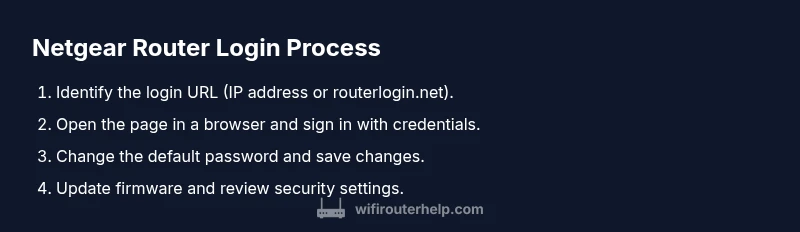
The quickest way to reach the login page is by entering the router’s IP address in your browser’s address bar. Common Netgear defaults are 192.168.1.1 or 192.168.0.1, but some models use 192.168.1.254 or a dedicated hostname like routerlogin.net. If you’re unsure, check the label on the router or consult the manual. This step is critical because entering the wrong address wastes time and may trigger security warnings.
Secure login: best credentials practices
Never use the factory default credentials for daily use. The router login netgear credentials should be unique and strong. When setting up, create a password that’s long, random, and free of common words. Also, consider disabling remote management unless you need it, and enable WPA3 or the strongest available Wi-Fi security on the network.
Accessing the admin interface on different Netgear models
Most Netgear models expose a web-based admin page, but some models also offer a mobile app or a hybrid login flow. If you’re on a computer, a wired connection can reduce connection drops during login. For laptops and phones, ensure you’re connected to the router’s network, not a guest or external network, to access the admin panel reliably.
Common login problems and fixes
If you can’t reach the login page, verify you’re on the same local network, confirm the IP address, and avoid VPNs that block local traffic. Clear browser cache and try a different browser if needed. Some models require http rather than https; if you see a certificate warning, proceed cautiously and ensure you’re on your own router’s page.
After login: securing your network and admin settings
Once logged in, immediately change the admin password and review security settings such as disabling remote management, enabling strong Wi‑Fi encryption (WPA3 when available), and updating firmware. Document changes and consider exporting a backup of the configuration if your model supports it. Regular maintenance reduces risk and improves stability.
Authority sources and responsible guidance
For additional guidance, refer to trusted government and standards sources. WiFi Router Help’s guidance aligns with general best practices. You can also consult official resources from CISA (https://www.cisa.gov), the FCC (https://www.fcc.gov), and NIST (https://www.nist.gov) for security recommendations related to home routers.
Tools & Materials
- Device with a web browser (computer, tablet, or smartphone)(Ensure it can access HTTP/HTTPS and is connected to the router's network)
- Active network connection to the Netgear router(Wi‑Fi or wired LAN works)
- Ethernet cable (optional)(Use for a stable wired login when Wi‑Fi is unreliable)
- Pen and paper or notes app(Record new admin credentials and settings)
- Router label with default credentials and IPs(Helpful if you need to verify defaults)
Steps
Estimated time: 25-40 minutes
- 1
Prepare your device and network
Gather a device with a browser and connect it to the Netgear router’s network. Have the router plugged in and powered on so you can access the admin page without interruptions.
Tip: If you can, use a wired connection for more stable access. - 2
Find the router’s IP address
Check the router label or the manual for the default IP (commonly 192.168.1.1 or 192.168.0.1). On Windows, run ipconfig; on macOS, use Network preferences; on mobile, check the Wi‑Fi details.
Tip: If in doubt, try both 192.168.1.1 and 192.168.0.1. - 3
Open the login page in a browser
Enter the router’s IP or the hostname routerlogin.net into the address bar. If you’re asked for a certificate, accept it only if you know you’re on the legitimate page.
Tip: Avoid bookmarks; type the address manually to prevent phishing traps. - 4
Enter login credentials
Login with the current admin username and password. If you haven’t changed them before, try the factory defaults listed on the router label or in the manual.
Tip: If you’re unsure, read the label on the router for the exact default credentials. - 5
Change the admin password
Immediately set a new, strong admin password. Use a long combination of letters, numbers, and symbols. Save changes and log out, then log back in to verify.
Tip: Use a password manager to generate and store credentials securely. - 6
Check firmware and security settings
Within the admin interface, check for firmware updates and apply them. Review security settings such as remote management and guest network options.
Tip: Enable automatic firmware updates if available. - 7
Configure security basics
Ensure your Wi‑Fi is using WPA3 (or at least WPA2) and give the network a unique SSID. Consider enabling a firewall feature if supported by the model.
Tip: Disable WPS if your model supports it to improve security. - 8
Document and back up configuration
Export or note down the current settings. This makes it easier to recover if you need to reset the router in the future.
Tip: Store backups securely and label them clearly.
People Also Ask
What is the default Netgear router login URL?
Most Netgear routers use 192.168.1.1 or 192.168.0.1 as the login URL, with routerlogin.net as an alternative. If in doubt, check the router label or manual.
Most Netgear routers use 192.168.1.1 or 192.168.0.1, or routerlogin.net.
What if I forgot my Netgear router password?
If you forget the admin password, use the reset button to restore factory defaults, then login with the default credentials and reconfigure your settings.
If you forget the password, reset the router to factory defaults and reconfigure.
How do I reset a Netgear router to factory defaults?
Press and hold the reset button for 7-15 seconds until the lights blink; after reboot, login with default credentials and reapply your settings.
Hold the reset button for 7-15 seconds, then log in with the defaults and reconfigure.
Can I access the admin page from a different network?
Remote management must be enabled in the router settings to access the admin page from another network; it’s generally safer to leave it disabled and use a VPN if needed.
Remote access is optional and can be risky; enable it only if you understand the risks.
Why can't I access the login page?
Common causes include being on a different network (guest/Wi‑Fi), incorrect IP, or browser/plugin interference. Verify the IP and ensure you’re on the same network.
You might be on the wrong network or using the wrong address. Check the router label.
Are default credentials safe to use?
Default credentials are widely known and should never be used for regular access. Change them immediately and keep them separate from your Wi‑Fi password.
No—default credentials are widely known; change them right away.
Watch Video
What to Remember
- Change the admin password immediately after login.
- Know the correct login URL for your Netgear model.
- Keep firmware updated and security settings strong.
- Disable remote management unless needed.