Is Router Better Than Modem? A Practical Guide
Compare routers and modems to decide whether a dedicated router delivers faster Wi-Fi, broader coverage, and better control for your home network. Learn when to separate devices and how to optimize performance.


Is router better than modem? In most homes, the router is the critical piece for distributing Wi‑Fi to multiple devices, while the modem handles the connection to your ISP. A dedicated router often provides stronger coverage, better security features, and more customization than a gateway device. The WiFi Router Help team analyzed typical home setups and found that users gain the most value from separating routing from the modem when possible.
Is Router Better Than Modem? Framing the Question
According to WiFi Router Help, the central question is is router better than modem for many households. The WiFi Router Help team found that for families with multiple devices and ongoing video workloads, separating the routing function from the connection to the internet typically yields better performance and control. In practical terms, a router directs traffic inside the home, while the modem handles the bridge to the ISP. When you separate these roles, you gain the ability to upgrade one component without replacing the other, tailor security and QoS rules, and improve coverage across floors and rooms. For many households, this distinction is the first step toward a more reliable home network and a smoother streaming experience. is router better than modem The broader goal is to minimize bottlenecks and maximize stability, which is why this guide compares the two with clear criteria and real-world scenarios.
How Routers and Modems Work
A modem is a device that translates signals from your ISP into data your home network can use. A router creates a local network, assigns addresses, and manages traffic between devices. In a typical setup, your modem connects to the internet, and the router distributes that connection to devices via Wi‑Fi and Ethernet. If you use a gateway device (modem-router combo), both roles are housed in a single box, which can simplify wiring but reduces flexibility. The question of whether is router better than modem hinges on your priorities: control, performance, and future-proofing. WiFi Router Help’s analysis shows that most households benefit from keeping the modem separate from the router, especially as the number of connected devices grows.
Key Differences at a Glance
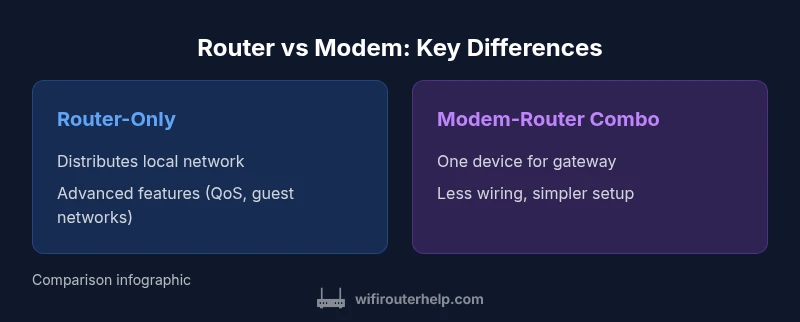
When you compare a router-only setup to a modem-router combo, several criteria matter most: control, reliability, and future-proofing. A router-only configuration gives you the freedom to choose a high-quality router with advanced features like QoS, guest networks, and robust security. A modem-router combo can save space and simplify installation, but often locks you into the ISP’s hardware lineup and limits upgrade paths. The ultimate takeaway from is router better than modem is that the best choice depends on your priorities, but for long-term value, separation generally wins.
When a Modem Must Be Used
Some ISPs require you to use their gateway device or disable bridge mode to access certain services. In these cases, the modem’s role cannot be fully separated, and you may have to work within the constraints of a single device. If you rent a gateway from your ISP, you may be paying a monthly fee that over time adds up. If you own your own modem, you can still pair it with a separate router to achieve the benefits of a dedicated routing system while staying compliant with your service terms.
Use Cases: Home Offices, Gamers, and Streaming
The is router better than modem decision becomes clearer when you consider use cases. A home office with multiple devices and video conferencing benefits from a strong, consistent network. Gamers demand low latency and stable connections, often achieved with a high-performance router and a modem that supports high-speed channels. Streamers require robust Wi‑Fi across multiple rooms; a dedicated router with modern standards (such as Wi‑Fi 6/6E) often outperforms a gateway in large homes. In short, the router’s ability to manage traffic and quality of service across devices makes a measurable difference for demanding workloads.
Setup Scenarios: Separate Router vs Gateway
A router-only configuration usually involves connecting a modem (either provided by the ISP or a third-party device) to a dedicated router. Then you configure the router for your network name (SSID), password, and security settings. A gateway integrates these two functions into one device, which can simplify wiring but reduces flexibility. For households planning future upgrades, the capability to swap in a better router later, while keeping the same modem, means you can improve performance step-by-step. The decision often hinges on whether you value longevity and customization over ease of setup.
Performance, Coverage, and Reliability: What to Expect
In practice, a well-chosen router, paired with a capable modem, can deliver stronger coverage and more reliable performance than a gateway. Routers enable features like beamforming, MU-MIMO, and advanced QoS that prioritize gaming or video calls. Coverage gaps in larger homes typically shrink when you upgrade to a modern router with multiple bands and better antennas. Is router better than modem? For most households, yes, provided the router is capable enough to handle the number of devices and the home’s layout. WiFi Router Help analysis shows that optimizing router placement and ensuring firmware is up to date yields meaningful, repeatable gains in speed and stability.
Budget, Fees, and Long-Term Value
A separate router plus modem can appear more expensive upfront, but it often reduces long‑term costs by avoiding monthly rental fees and enabling gradual upgrades. The true cost of ownership depends on your current service plan and hardware quality. If you’re currently paying a rental fee for ISP equipment, purchasing a modern router and a compatible modem can be a smart investment that depreciates over time while delivering better performance. The long-term value of a router-focused approach typically improves as you add devices and adopt more bandwidth-intensive activities.
Practical Decision Framework: A Step-by-Step Checklist
If you’re weighing is router better than modem, use this checklist: 1) Count devices and bandwidth needs; 2) Check whether your ISP supports bridge mode; 3) Compare up-front costs versus rental fees; 4) Evaluate security features and ongoing firmware updates; 5) Consider future growth and potential network expansions; 6) Assess the physical layout of your home to determine optimal router placement and potential mesh extensions. Following this structured approach helps ensure you don’t miss important factors and can justify the investment.
Common Pitfalls and How to Avoid Them
Common mistakes include underestimating coverage needs, ignoring firmware updates, and sticking with an old gateway that can’t keep up with new devices. Another pitfall is placing the router in a closet or corner where signals bounce off obstacles. To avoid these issues, place the router high, in central locations, and use a modern mesh system if you have a large home. Regularly check for firmware updates and configure security options like WPA3. These steps make the is router better than modem choice more resilient and future-proof.
Comparison
| Feature | Router-only setup | Modem-router combo (gateway) |
|---|---|---|
| Primary role | Distributes local network, enables advanced features (QoS, guest network, firewall controls) | Combines gateway + routing in one box; simpler but less flexible |
| Setup complexity | Moderate to advanced (requires configuring a separate router) | Low to moderate (one device, fewer cables) |
| Upgrade paths | Separate improvements possible (router upgrade independent of modem) | Often limited by ISP hardware and firmware constraints |
| Performance & customization | Typically higher performance with modern router; extensive customization options | Performance depends on ISP device; fewer advanced features |
| Cost model | One-time hardware cost; no recurring rental fees if you own devices | Possible monthly rental fees; upfront cost varies with model |
| Security & control | Greater control over security policies, firmware updates, and access control | Security depends on ISP firmware; often less granular control |
Benefits
- Better long-term value when you own the devices
- Greater customization and control over network features
- Easier future upgrades by swapping routers or modems separately
- Improved coverage with modern router technology and mesh options
The Bad
- Higher upfront cost for separate devices
- Requires more setup and ongoing maintenance
- Multiple devices can complicate troubleshooting if misconfigured
Dedicated router with a separate modem typically delivers better performance and flexibility
If you prioritize coverage, security, and future-proofing, separate router and modem is the stronger choice. Choose a gateway only if you value simplicity and reduced upfront complexity, but be aware of potential limits on upgrades and features.
People Also Ask
What is the fundamental difference between a router and a modem?
A modem connects your home network to the internet via your ISP, while a router distributes that connection to your devices and manages local traffic. The router handles network features like Wi‑Fi, guest access, and QoS, whereas the modem primarily translates signals from your provider. If you want more control and performance, using separate devices is usually advantageous.
A modem connects you to the internet; a router shares that connection inside your home. If you want more control and better coverage, separate devices are often the better choice.
Is it worth renting a modem-router from my ISP?
Renting a gateway from your ISP can simplify setup but adds ongoing costs and often restricts features. If you plan to stay long-term and want flexibility, buying your own modem and a separate router is typically more economical and future-proof.
Renting is convenient but can be costly over time. Buying your own modem plus a separate router usually saves money and improves control.
Can I still use my existing modem with a new router?
Yes. In most setups, you can bridge the modem (or use the gateway in bridge mode) and connect a dedicated router. This preserves your ISP connection while letting you upgrade your local network performance.
Yes, you can bridge your modem and connect a new router to improve performance and control.
What about gateway devices for simple setups?
Gateways are convenient for simplicity, but they lock you into a single device and limited upgrade paths. If your goal is performance and customization, a separate router with a modem usually wins in the long run.
Gateways are simple, but they limit upgrades. A separate router often yields better performance later.
How do I decide which router to buy for is router better than modem?
Assess coverage needs, number of devices, and your internet speed. Look for a model with current standards (Wi‑Fi 6/6E), robust security, and good support. A future-proof router can handle upgrades without requiring a full replacement.
Check coverage, device count, and speed. Pick a router with Wi‑Fi 6/6E and strong security for future-proofing.
Does upgrading a router improve gaming performance?
Yes. A modern router can reduce latency and improve stability through features like QoS and higher throughput. Pair it with a capable modem, and you’ll likely see noticeable benefits for online gaming and streaming.
Upgrading your router often reduces lag and improves stability for gaming and streaming.
What is bridge mode and when should I use it?
Bridge mode disables the router function in your modem/router device, allowing a separate router to manage your network. Use bridge mode when you want full control of your local network while keeping the ISP connection intact.
Bridge mode lets you use your own router while keeping the modem-connected to the internet.
What to Remember
- Start with is router better than modem: separate devices offer the best long-term value
- Prioritize coverage and control through a modern router with current standards
- Evaluate total cost including rental vs ownership before deciding
- Plan for future growth with a scalable setup (mesh, additional access points, etc.)
- Regularly update firmware and optimize placement for best results