Router is Flashing Green: Quick Troubleshooting Guide
If your router is flashing green, start with basics, follow a structured diagnostic flow, and restore stability safely. This urgent guide from WiFi Router Help walks you through checks, fixes, and when to seek professional help.


A flashing green light on most consumer routers can indicate a boot/diagnostic state or a firmware update in progress. Start with the simplest checks: unplug and replug the power, verify the Ethernet and WAN cables, and reboot the router. If the light pattern persists, follow the diagnostic flow to isolate the cause.
What the flashing green light signals
According to WiFi Router Help, a flashing green light on many routers often signals that the device is in a boot or diagnostic state, or that a firmware update is underway. This status can be model-specific, but the underlying message is consistent: the router is actively attempting to start, update, or recover from a process that affects normal operation. If you see the phrase router is flashing green on your device, you’re not alone, and there are safe, repeatable steps you can take. The WiFi Router Help team notes that light behavior is often the first and most reliable indicator of what’s happening behind the scenes. Understanding the pattern is the key to avoiding unnecessary resets and data loss. In most cases, a green LED that blinks briefly or remains intermittently lit points to a non-destructive process; however, extended blinking or a new right-left pattern can signal a deeper issue requiring action. Recognize that the goal is to restore stable connectivity while preserving configurations when possible.
Safety and basic checks you should perform first
Before diving into advanced troubleshooting, perform a quick safety and setup sanity check. Ensure you are operating in a safe environment with the router plugged into a stable, surge-protected outlet. Confirm you’re using the original power adapter and that the cable connections to the modem (if you have a standalone modem) and to the router are snug at the ports. The router’s blinking green light often reacts to loose cables or power fluctuations, so reseat all connections firmly. If possible, test with a different Ethernet cable to rule out a faulty wire. Do not attempt high-risk electrical repairs. The goal is to rule out basic, non-invasive causes before proceeding to more complex steps. The WiFi Router Help guidance emphasizes starting with the simplest fixes to save time and reduce risk. When you’re ready to proceed, you’ll have a clearer picture of whether this is a transient state or a more serious fault that requires deeper investigation.
Interpreting green light patterns: solid vs blinking vs pulsing
A green LED can take several forms, and each form has a likely meaning. A solid green light often indicates the device is online and functioning, while a blinking green light can signal activity like firmware updates or network traffic. If the light is blinking in a steady, rhythmic pattern, that can indicate a device in boot mode or undergoing a diagnostic check. A pulsing green LED may indicate the router is applying settings or performing a reset sequence. Different manufacturers implement LED semantics differently, so consult your model’s manual for precise interpretations. In general, if the blinking green persists well beyond the typical update duration, you should proceed with diagnostic flow steps rather than assuming a minor glitch. Keep a log of LED states to track whether patterns repeat under certain conditions. WiFi Router Help suggests documenting the pattern helps you communicate clearly with support if you need to escalate.
Common causes and practical fixes
Many issues that cause a router to display a flashing green light are fixable with simple steps. The most common cause is a firmware update in progress or a failed update, which can leave the device in a transitional state. Power supply instability can also trigger green blinking; ensure the power adapter is the correct one for your model and that the outlet is stable. A loose or damaged Ethernet cable between the router and modem, or a misconnected WAN port, can also produce light signals that mislead you about the device’s status. Overheating can trigger protective shutdowns; ensure adequate ventilation and that vents are not blocked. If you recently changed settings or performed a reset, verify that you are still connected to the correct network. If basic checks do not resolve the issue, move to the diagnostic flow steps to identify the root cause and apply precise fixes.
Should you reset to factory settings, and when?
Factory resets should be a last resort because they erase custom configurations like Wi-Fi names, passwords, and QoS rules. Only perform a reset if you have exhausted non-destructive fixes and you have the means to reconfigure the router (or have a saved backup). If you must reset, plan for a 10–20 minute reconfiguration window. After a reset, reapply firmware updates and re-enter your ISP credentials if applicable. The WiFi Router Help approach emphasizes preserving settings whenever possible, and documenting your current configuration makes reconfiguration faster if you choose to reset.
Firmware updates, ISP interaction, and how they relate to the green light
Many green light scenarios involve firmware activity. If your router is part of a combined modem/router from your ISP, firmware management can be more complex because the ISP may push updates to both devices. During such updates, it is normal to see the LED blink green; however, if the blinking continues for an extended period, there may be a stalled update or a compatibility issue with your firmware version. In some cases, a simple reboot can finalize an update; in others, you may need to access the router’s admin interface to verify the update status or manually trigger a retry. The WiFi Router Help team recommends checking the manufacturer’s site or your ISP’s support portal for update instructions and versions appropriate for your device.
Physical and environmental factors: overheating, ventilation, and placement
Poor ventilation and blocked vents can lead to thermal throttling or automatic shutdowns that manifest as abnormal LED behavior, including a flashing green light. Ensure the router sits on a hard, level surface with ample space around it for airflow. Avoid stacking devices or placing the router in enclosed cabinets or near heat sources. Power fluctuations from a shared circuit can also affect LED patterns; if your area has unstable power, consider using a UPS (uninterruptible power supply) to protect network equipment. Addressing these environmental concerns can prevent recurrence of green-light anomalies and extend device life.
Documentation, logs, and what to tell support
Keeping a log of LED patterns, time stamps, and recent changes provides valuable context for troubleshooting. Note when patterns begin, how long they last, and any actions you took (including firmware updates or resets). When contacting support—whether WiFi Router Help or your ISP—provide the model number, current firmware version, and the observed LED pattern. Clear logs compress the diagnosis timeline, save you time, and reduce frustration. The WiFi Router Help team emphasizes that precise, documented details help technicians reproduce and diagnose the issue more efficiently.
Preventive care: best practices to avoid future flashing green issues
To minimize future green-light issues, keep firmware updated, but avoid frequent manual updates unless necessary. Maintain clean airflow around the router, use a stable power source, and only perform resets when needed. Regularly back up your router settings so you can restore quickly after a reset. Monitor network traffic to detect unusual activity that might indicate misconfiguration or a compromised device. Practicing these habits reduces the odds of recurrent green-light conditions and keeps your home network stable.
A closing note from WiFi Router Help: practical next steps
The WiFi Router Help team recommends proceeding with caution and following a structured diagnostic path rather than jumping to drastic remedies. By documenting LED patterns, verifying power and cables, and using the admin interface to confirm firmware status, you can often resolve the issue without professional intervention. If the problem persists after completing the diagnostic flow, reach out to your device manufacturer support or your ISP for escalation, ensuring you have your logs ready for a faster resolution.
Steps
Estimated time: 30-45 minutes
- 1
Power cycle with a stable supply
Unplug the router from power, wait 30 seconds, plug back in, and allow the device to boot fully. This clears transient states that can trigger a green blink. Observe the LED pattern for 5–10 minutes as the device boots.
Tip: Use a surge-protected outlet to avoid fluctuations. - 2
Check physical connections
Inspect all cables between your modem, router, and any switches. Reseat each connector firmly to ensure a solid link. If you’re using a fiber or cable gateway, verify the correct port connections (WAN vs LAN).
Tip: Try a different Ethernet cable if you have one. - 3
Access the router admin page and check firmware
Log into the router’s admin interface using the local IP (commonly 192.168.1.1). Look for firmware update status and any pending updates. If an update is in progress, avoid power cycling unless instructed by the UI.
Tip: Grab the exact firmware version before you retry an update. - 4
Review recent changes and settings
If you recently changed settings, revert to previous values or disable recently added features (like parental controls or UPnP) to see if the green light stabilizes. Some misconfigurations can trigger diagnostic states.
Tip: Document changes so you can revert precisely. - 5
Check for overheating and ventilation
Ensure the router sits on a hard surface with unobstructed airflow. Clear nearby objects that could trap heat. Prolonged overheating can cause protective states indicated by LED patterns.
Tip: If possible, relocate to a cooler spot until stable. - 6
Test with a factory reset (only if necessary)
If all non-destructive steps fail, consider a factory reset. Back up your settings first. After reset, reconfigure from scratch or restore a saved backup.
Tip: Factory reset should be your last resort. - 7
Re-run updates and verify connectivity
After any reset, reapply firmware updates and verify your internet connection by performing a speed test and checking device reachability on your network.
Tip: Keep a note of settings you had before the reset. - 8
Escalate if the issue persists
If the green light continues after following the steps, contact the device manufacturer’s support or your ISP. Have logs ready with LED patterns, firmware version, and steps you attempted.
Tip: Provide the exact model and firmware version for faster help.
Diagnosis: Router light shows green blinking instead of expected solid green or off
Possible Causes
- highFirmware update in progress or failed update
- highPower supply instability or incorrect adapter
- mediumLoose/corrupted Ethernet or WAN cable
- lowHardware fault or overheating
Fixes
- easyWait for firmware update to complete, monitor LED for progress
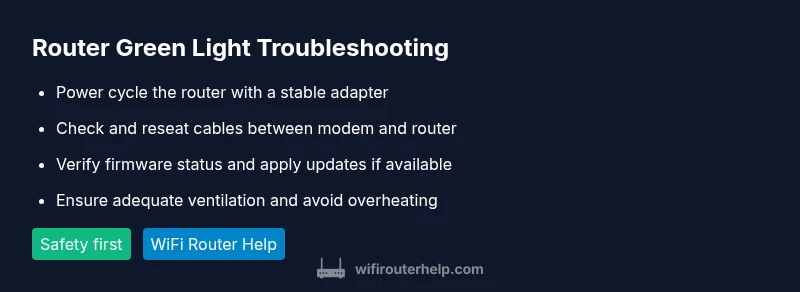
- easyPower cycle the router with a stable adapter and outlet
- easyReseat or replace Ethernet/WAN cables and ports
- easyCheck ventilation, move router to better location, consider replacement if overheating
People Also Ask
What does a blinking vs solid green light mean on my router?
Blinking patterns often indicate activity like boot, updates, or diagnostic checks, while a solid green usually means normal operation. Check the pattern against your model’s manual. If the blinking persists beyond expected update times, follow the diagnostic flow.
Blinking usually signals activity like an update or boot; solid green usually means normal operation. Check your model’s guide and follow the diagnostic steps if it keeps blinking.
Is a flashing green light dangerous for my network security?
A flashing green light is typically a hardware or update indicator, not a direct security threat. However, it can coincide with misconfigurations or software updates. Stay vigilant, ensure firmware is current, and avoid exposing ports unnecessarily.
No, the light itself isn’t a security threat, but you should verify firmware is up to date and check your network settings.
Should I reset my router if the light is flashing green?
Only reset if you have exhausted non-destructive steps and you have backups of your settings. A reset will erase customized networks and passwords, so reconfigure carefully afterwards.
Reset only after trying other fixes and after backing up your settings.
Can a firmware update cause a flashing green light?
Yes. A firmware update can cause the LED to flash green as the device applies changes. If an update is stuck, try a power cycle or check the UI for update status before retrying.
Firmware updates can cause a green flash; check the update status in the router UI if possible.
What should I do if the light is still flashing after following the guide?
If the light persists, gather LED pattern logs, model, and firmware version, then contact support with these details. A technician may need to check for hardware faults or ISP-related issues.
If it keeps flashing, collect details and contact support for deeper diagnostics.
Watch Video
What to Remember
- Start with power and cable checks.
- Don’t rush to reset; verify firmware status first.
- Document LED patterns for faster support.
- If issues persist, escalate to manufacturer/ISP with logs.