Which Router Is the Cheapest? A Practical Buying Guide
Learn how to spot the cheapest router without sacrificing essential performance. This guide explains price ranges, core features, and practical tips for budget home networks.


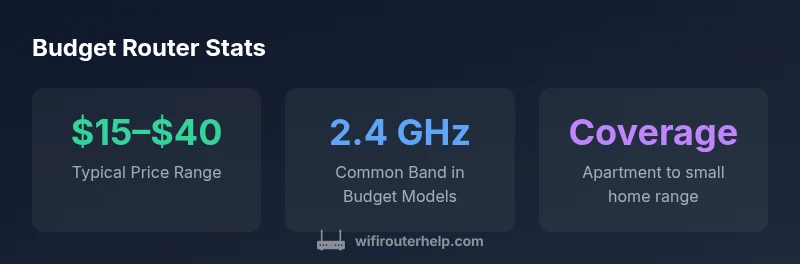
The cheapest routers typically fall in the $15–$40 range, with basic models often under $25. If you’re buying for a small apartment or guest network, expect functional coverage at the low end, while more features push price higher. For the cheapest option, look for single-band 2.4 GHz models with simple security.
What 'the cheapest' means in router shopping
When shoppers search for the cheapest router, and when someone asks which router is the cheapest, they're often chasing the lowest purchase price, not the best overall value. According to WiFi Router Help, the cheapest option should still meet your basic needs: stable coverage, reasonable throughput, and entry-level security. The WiFi Router Help team found that many budget purchases fail to deliver consistent signals in larger rooms due to antenna design and placement. Before you buy, map your home layout, identify device density, and set a target area to cover. By focusing on geographic coverage first, you can pick an affordable model that actually supports your everyday tasks rather than chasing the lowest price at the expense of reliability.
Essential features that cheap routers should still offer
Even at a tight price point, you should look for a handful of features that protect performance and security. Prioritize models that support 2.4 GHz and 5 GHz dual-band operation (not just 2.4 GHz), at least WPA3 security, and a straightforward firmware update process. Basic QoS controls help keep video conferencing stable, while a guest network keeps your main network secure when visitors connect. If a budget model lacks automatic updates or strong encryption, it's worth considering a small upgrade rather than risking holes in your home network. Placement matters too: a compact router placed centrally can dramatically improve coverage without increasing price.
Price tiers and typical use cases
Budget routers fall into several practical tiers. For very light use—email, web browsing, and occasional streaming in a small apartment—a basic single-band or modest dual-band model in the $15–$30 range is commonly enough. For households with multiple devices, online classes, and a few smart devices, expect the $25–$60 bracket to offer better coverage and more stable connections. If your home is larger or you have many smart devices, you may need to push toward the $60–$120 range, where budget mesh-ready or tri-band options begin to appear. Remember, price is not the only measure of value; available ports, ease of use, and customer support matter as well.
How to test performance and verify real-world results
After selecting a budget router, verify that it meets your needs in real-world conditions. Start with a simple speed test from your main living area and then test from bedrooms and other far rooms to gauge coverage. Use multiple devices to simulate real usage: a laptop for work, a video call device, and a few smartphones streaming video. Check the router’s admin interface for firmware updates and ensure you enable WPA3 security and enable guest network if needed. Finally, optimize placement: elevate the router off the floor, away from thick walls, and away from other electronics that cause interference. Small tweaks can yield meaningful gains without spending more.
Common myths and practical tips
Myth: cheapest routers can’t handle modern networks. Truth: many budget models deliver solid performance if you manage settings and placement carefully. Myth: you must buy at least twice as expensive to get reliable coverage. Truth: effective coverage depends on layout and interference, not just price. Practical tip: buy from retailers with easy returns so you can test in your home; upgrade only when you truly need more range, more devices, or higher speeds.
Budget router price tiers and capabilities
| Router Type | Typical Price Range | Wi-Fi Standards | Common Use Case |
|---|---|---|---|
| Single-band 2.4 GHz | $15–$25 | 802.11n / 2.4 GHz | Email, light browsing, basic streaming |
| Dual-band 2.4/5 GHz | $25–$60 | 802.11ac / Wi‑Fi 5 | General home use, multiple devices, HD streaming |
| Budget mesh-ready or tri-band | $60–$120 | Wi‑Fi 5/6 + mesh-ready | Larger homes, many devices, smart-home hubs |
People Also Ask
What features should I look for in the cheapest routers?
For the cheapest options, prioritize dual-band capabilities, WPA3 security, regular firmware updates, and a straightforward admin interface. These help ensure reliable performance and security without adding unnecessary cost.
Look for dual-band support, good security, and easy updates; they matter more than raw speed on a budget.
Is it worth buying a refurbished budget router?
Refurbished models can offer good value if backed by a warranty and tested to work properly. Check seller reputation and ensure you can return if performance doesn't meet needs.
Refurbished can be worth it if you get a warranty and can test it at home.
Can the cheapest router handle multiple devices?
Many budget routers handle several devices, but performance can degrade with heavy traffic. If you have many smart devices or 4K streaming, expect a larger budget range or a mesh setup.
It can handle multiple devices, but heavy use may require a budget-friendly upgrade.
How can I improve performance on a budget router?
Place the router centrally, update firmware, enable QoS when possible, and use a 2.4 GHz network where signal strength is stronger. Reducing interference from nearby devices also helps.
Move the router higher, update firmware, and reduce interference to improve performance.
What is the difference between single-band and dual-band in cheap routers?
Single-band routers operate only on 2.4 GHz, offering lower speeds and simpler setups. Dual-band adds 5 GHz for less congestion and better performance for video calls and streaming.
Single-band uses only 2.4 gigahertz; dual-band adds 5 gigahertz for less congestion.
“A budget router can deliver excellent value when you balance coverage, security, and easy setup; price alone won't tell the full story.”
What to Remember
- Define your network needs before buying to avoid overpaying.
- Prioritize coverage and security features over the cheapest price.
- Compare price ranges across real-world use cases.
- Test performance in your home before finalizing the purchase.
- Choose models with ongoing firmware updates for long-term value.