Cisco Router Price in 2026: A Practical Guide
Explore Cisco router price ranges, what drives cost, and how to choose the right price tier for home, SMB, or enterprise networks with practical budgeting tips.


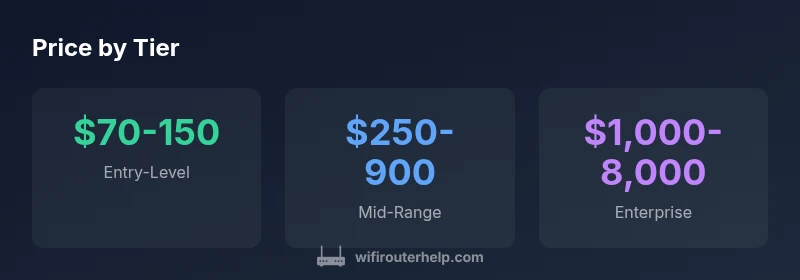
Cisco router price varies widely by model, feature set, and licensing. For most small businesses and homes, entry-level Cisco routers start around $70-$150, mid-range options range from $250-$900, and enterprise-grade devices can exceed $1,000 up to several thousand dollars. This quick guide explains how price reflects performance, security, and support.
Why Cisco router price varies across models
Cisco router price varies widely because Cisco segments the market into entry-level consumer/SMB devices, mid-range security routers, and enterprise-grade systems with advanced routing, high throughput, and extensive licensing. According to WiFi Router Help, the same vendor’s devices can differ by hardware acceleration, firewall capabilities, VPN support, and service contracts, which all push price in different directions. In addition, licensing for security features, threat prevention, and ongoing updates adds recurring costs. As a result, the 'cisco router price' you see is not just the sticker on the box; it’s a reflection of performance, resilience, and the level of vendor support you expect. When evaluating costs, consider your current network size, growth projections, and whether you need features like site-to-site VPN, advanced QoS, or integrated threat protection.
- Real-world deployments show that cost scales with throughput and port density.
- Hardware acceleration for encryption and routing can add to the upfront price but reduce latency under load.
- Ongoing maintenance contracts can significantly affect total cost of ownership.
This section lays the groundwork for understanding price by tier and how to align it with your network goals.
Pricing by product tier: entry-level to enterprise
Understanding the price tiers helps buyers map Cisco router price to network needs. Entry-level devices for home or small offices typically sit in the lower hundreds after promotions and channel discounts, offering basic routing, Wi‑Fi, and standard security features. Mid-range models jump into the several-hundred-dollar territory, adding higher throughput, more simultaneous connections, better security options, and more robust management features. Enterprise-grade routers begin around the low thousands and can reach into the thousands, driven by multi-gigabit throughput, advanced routing tables, expansive VPN capabilities, and premium service levels. Channel dynamics matter here: buying directly from Cisco, through authorized partners, or via authorized distributors can affect street prices due to volume discounts, bundled licenses, and support terms.
- Entry-level: suitable for small homes or tiny offices with basic needs.
- Mid-range: balances performance, security, and centralized management.
- Enterprise: designed for large campuses, data centers, or branch-heavy networks.
When you see a Cisco router price for a given model, supplement it with licensing costs and potential hardware upgrades to estimate your total outlay.
How features and licensing influence cost
Feature sets drive Cisco router price in meaningful ways. Core throughput, number of built-in ports, and support for multi-core processing determine hardware price. Security features like next-generation firewall (NGFW), IPS/IDS, and secure VPNs often require separate licenses. Licensing costs can be annual or perpetual and affect ongoing expenses even after the initial hardware purchase. Management capabilities—such as centralized dashboards, analytics, and zero-trust access—also influence price. In practice, you may see a modest hardware price with significant add-ons for security licenses or advanced software features. The WiFi Router Help team emphasizes weighing the incremental value of each license against your risk profile and compliance requirements.
- Budget for necessary licenses upfront if you require NGFW or advanced VPN features.
- Evaluate whether a bundled license offers savings compared with buying a la carte.
- Consider whether cloud management features are essential for your environment.
This section helps you estimate how much of the price is hardware versus software and services.
Where to buy and how purchase channel affects price
Price can vary by the sales channel. Authorized Cisco partners, distributors, and resellers may offer different discounts, bundles, and support terms. Direct-from-Cisco pricing often targets larger deployments with volume incentives, while education and nonprofit programs can provide additional reductions. Refurbished or reconditioned units from reputable sources may lower upfront costs but require careful verification of warranty and license transfer. If you have a mixed environment (staff laptops, IoT devices, branch offices), ask for a configuration that supports your deployment size to avoid overpaying for unused capacity. Always compare quotes from multiple channels and verify that licenses and support are transferable between accounts.
- Check for promotion periods and bundled licenses.
- Read the license transfer terms before buying refurbished units.
- Verify warranty coverage and response times for each channel.
Channel strategy matters as much as the hardware spec in achieving Cisco router price efficiency.
Budgeting for Cisco router purchases: total cost of ownership
A practical budgeting approach looks beyond the upfront Cisco router price to total cost of ownership (TCO). Consider the hardware cost, ongoing software licenses, support contracts (such as maintenance and bug fixes), and potential upgrade costs for future scalability. A robust deployment often requires security licenses, ongoing firmware updates, and replacement parts. Maintenance contracts can provide peace of mind with predictable support, but they add recurring expenses. For many organizations, a slightly higher upfront cost with comprehensive licenses and longer support is more economical than repeatedly paying for ad-hoc upgrades. In 2026, planning for TCO remains essential as networks demand higher throughput and stronger security features, which carry proportional cost.
- Estimate annual license and support costs as a fixed percentage of hardware price.
- Align upgrades with projected traffic growth and security needs.
- Build a contingency for unexpected licensing changes or policy updates.
This section helps you translate a catalog price into a sustainable budget plan.
Practical tips to maximize value without overspending
To maximize value in Cisco router price negotiations, compare MSRP with street pricing across channels, and look for bundles that include licenses, warranties, and professional services. Consider refurbished units from authorized refurbish programs where supported, keeping an eye on warranty terms and license eligibility. Invest in devices with upgrade paths (ports, modules, or software tiers) so you can expand capacity without a full replacement. Leverage vendor-approved training or documentation to configure features efficiently, reducing the risk of over-licensing. Finally, structure your procurement around a phased rollout, starting with core routing and security, then expanding to VPN and QoS as needed.
- Compare multiple vendors and request formal price quotes.
- Favor devices with clear upgrade paths rather than buying new mid-range devices prematurely.
- Use trial licenses when available to validate feature needs before committing.
With careful planning, you can achieve a balanced Cisco router price that meets performance goals without overpaying.
2026 price trends and what they mean for buyers
Price trends in 2026 are shaped by demand for higher‑throughput networks, stronger security requirements, and continued global supply chain adjustments. While entry-level devices remain affordable, the value of licenses and subscription services continues to be a major portion of total cost. Buyers should anticipate periodic price revisions tied to feature introductions, license restructurings, and policy changes from channel partners. The takeaway is to plan for both hardware and software costs, and to factor in long-term needs such as secure remote access, cloud management, and bandwidth growth. Staying informed through trusted guidance helps you time purchases and select configurations that deliver the best price-to-performance ratio.
- Monitor license renewal cycles to avoid sudden price spikes.
- Prioritize scalable solutions that match growth trajectory.
- Use a total cost of ownership lens to evaluate long-term value.
dataTableSectionEndPlaceholder
Cisco router price by product tier
| Category | Typical Price Range (USD) | Notes |
|---|---|---|
| Entry-level / Small business | 70-150 | Basic routing, Wi-Fi, standard security |
| Mid-range / SMB | 250-900 | Higher throughput, better security, centralized management |
| Enterprise / Campus | 1000-8000 | Advanced features, multi-gig throughput, extensive licensing |
People Also Ask
What drives the price differences between Cisco routers?
Price differences come from hardware capabilities, throughput, port density, and security licenses. Higher-tier models offer more features and longer support, which increases cost. Licensing is a frequent source of ongoing expenses beyond the initial purchase.
Price differences come from hardware, throughput, and security licenses. Higher tiers cost more but include more features and longer support.
Should I buy refurbished Cisco routers to save money?
Refurbished units can lower upfront Cisco router price, but verify warranty, license eligibility, and whether licenses transfer if required. Only buy from reputable refurbish programs and ensure you’ll still receive firmware updates and support.
Refurbished routers can be cheaper, but check warranty and license transfer.
How can I compare prices without overpaying?
Get quotes from multiple authorized channels, compare bundled licenses and support, and confirm license transfer terms. Consider total cost of ownership, including ongoing license costs, not just upfront price.
Get multiple quotes and consider total cost of ownership.
Is there a best time to buy Cisco routers?
Look for promotional periods, end-of-quarter discounts, or academic programs. Combine promotions with bundles that include licenses and support for better value.
Watch for promos and bundles to maximize value.
Do licenses affect performance after purchase?
Licenses unlock features that may enable higher security and throughput. Without the license, you may be limited to basic functionality and lower performance options.
Licenses unlock features that improve security and throughput.
“The right Cisco router price is found where hardware capacity, security licensing, and vendor support align with your network goals.”
What to Remember
- Understand price reflects features, licenses, and support, not just hardware
- Price tiers map to network size and performance needs
- Licensing can add 10-25% or more to hardware cost
- Shop across channels for discounts and bundled licenses
- Plan for total cost of ownership, not just upfront Cisco router price