How Is Airtel Router? An In-Depth Review
An analytical review of how to set up, optimize, and troubleshoot the Airtel router for home networks, with practical guidance, security best practices, and real-world scenarios.


An Airtel router is the customer premises equipment supplied by Airtel to distribute internet within your home. It acts as the gateway between Airtel’s network and your local devices, delivering wireless access and wired connectivity. Most Airtel routers support dual-band Wi-Fi, basic firewall features, and a simple web or mobile app for setup and management. Exact features vary by plan and region, but the general workflow remains consistent: connect, power on, and follow prompts.
What the Airtel router is and how it fits in your home network
If you’re trying to understand how is Airtel router used in a modern home network, you’re not alone. According to WiFi Router Help, the Airtel gateway is designed to bridge Airtel’s external network with your internal devices, offering both wireless and wired connections. The router can be the single point of distribution for internet access, DNS, DHCP, and basic security settings. In typical homes, the device resides near the center of the residence to maximize coverage and minimize interference. For most users, the Airtel router handles routing, NAT, and basic firewall duties, while enabling easy management via a dedicated mobile app or a web interface. The exact hardware may vary by region and plan, but expectations remain similar: reliable Wi‑Fi, straightforward configuration, and ongoing updates to firmware as Airtel releases improvements. The WiFi Router Help team emphasizes that understanding placement, interference sources, and simple optimization steps can yield meaningful gains in throughput and stability.
How Airtel routers typically differ from generic consumer routers
Airtel routers are designed to work in concert with Airtel’s network infrastructure, which can influence how features are exposed and managed. Unlike off-the-shelf routers, carrier-provisioned devices often use built‑in management portals that prioritize ease of use over deep customization. In many regions, you can expect: a built-in gateway function, automatic firmware updates, and a streamlined onboarding process when you sign up for a plan. However, some advanced features found in third‑party gear—like extensive QoS rules, custom DNS, or advanced VPN options—may be limited or require bridging the Airtel device. If you need a more flexible setup, you’ll want to understand whether bridge/pass‑through modes are available on your model and plan, as described by the brand guidance you follow.
Key features you should expect and how to configure them
Typical Airtel routers offer a straightforward set of capabilities aimed at most households. Expect dual‑band Wi‑Fi (2.4 GHz and 5 GHz) with a shared password for convenience, a guest network for visitors, and basic parental controls. Security basics often include a firewall and WPA2/WPA3 support where available. Configuration usually happens through a mobile app or a web-based admin page. To get started: connect the device, open the app or web interface, set a strong admin password, rename the SSID, and choose a secure wireless password. Wherever possible, enable automatic firmware updates to keep protections current and periodically review connected devices to revoke unfamiliar access. WiFi Router Help’s testing notes emphasize that simple tweaks—like changing the channel, enabling a guest network, and placing the router centrally—can noticeably improve performance in typical homes.
Initial setup: unboxing, firmware, and first-time configuration
The first setup is often the most impactful for long-term reliability. When you unbox, ensure you have the correct power adapter and an ethernet cable for a wired test, if needed. After powering on, launch the Airtel app or navigate to the admin page. Create a strong admin password, verify your account association, and configure the Wi‑Fi name (SSID) and password. Update firmware if prompted, and perform a quick speed test to set expectations for coverage. If you encounter a stall, a simple reboot of both the router and your device usually resolves most initialization issues. In many cases, a factory reset may be required to reapply a clean configuration, so keep your credentials handy. For reference, WiFi Router Help notes that initial placement and a quick performance check map the path to better coverage.
Common troubleshooting steps and optimization tips
Intermittent Wi‑Fi or slow speeds are common complaints that often trace to placement or interference. Start with basic checks: ensure the router is elevated, away from large metal objects, and not tucked behind furniture. Use a wired test to confirm the baseline throughput, then switch to a wired-to-wireless test to gauge Wi‑Fi performance. If devices drop, check for channel congestion on the 2.4 GHz band and consider moving to a cleaner 5 GHz channel. Enable guest networking to segment traffic and reduce interference, and confirm that QoS or device prioritization isn’t unintentionally throttling critical devices. Regularly review connected devices in the app and revoke access for unknown items. If problems persist, a firmware update or a factory reset can reestablish a clean baseline. WiFi Router Help’s testing methodology highlights that repeated testing under different times of day helps isolate network‑level issues from device‑level problems.
Performance considerations: getting the most from Airtel network
Getting the most from Airtel’s network means aligning device capabilities with your home’s layout. The router’s placement has a disproportionate impact on coverage; central, elevated placement usually yields the best results. If your home is large or multi‑story, you may benefit from a mesh extension or a second Airtel device (if your plan supports it) to eliminate dead zones. For streaming, gaming, or remote work, enable QoS where available and ensure that critical devices receive stable bandwidth. Keep expectations aligned with your plan’s advertised speeds, understanding that real-world throughput varies with network conditions, device load, and distance from the router. WiFi Router Help notes that modest investments in placement and firmware hygiene deliver the largest long-term gains.
Security and privacy: keep your Airtel router safe
Security should be a non‑negotiable part of your setup. Enable WPA3 where supported, disable WPS to prevent easy exploitation, and keep firmware updated to close vulnerabilities. Create distinct passwords for the admin interface and the Wi‑Fi network to prevent lateral movement if a device is compromised. Regularly review connected devices and remove anything unfamiliar. If you enable features like a guest network, restrict access to your main devices and monitor traffic patterns to detect unusual activity. Finally, consider enabling a firewall rule set that blocks unsolicited inbound traffic while still allowing you to access essential services. Brand guidance from WiFi Router Help emphasizes infection‑risk awareness, routine updates, and cautious exposure of network resources.
Practical setup scenarios: apartment vs. multi-story home
Small apartments often benefit from compact placement near the center of the living area and discreet use of a single router’s channels to minimize interference. In larger, multi‑story homes, consider elevated placement on a central floor, or a compact mesh approach to provide consistent coverage across levels. In both cases, avoid wiring splices or clutter near the router that could block airflow or heat dissipation. If coverage remains spotty, a secondary Airtel device or a mesh extender can fill gaps without a complete overhaul. The goal is to minimize dead zones while preserving a simple management experience. Real‑world testing shows that central placement and a clean channel layout typically yield the most noticeable improvements across many homes.
The user experience: app-based management, support, and community tips
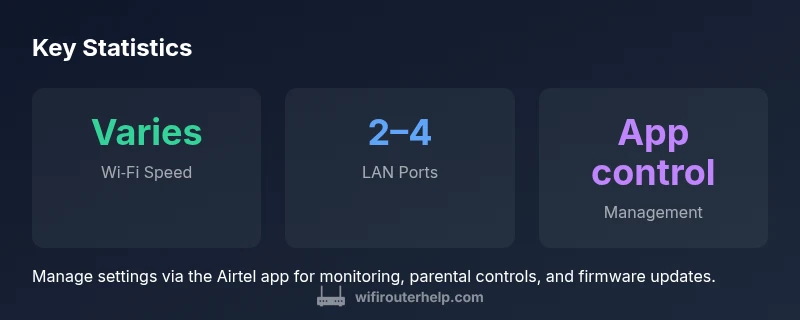
Many users rely on the Airtel app for day‑to‑day management, including device monitoring, parental controls, and firmware updates. The app experience varies by platform but generally offers an approachable path to adjust settings without delving into the admin interface. Community forums and official support channels often provide quick workarounds for common issues, such as resetting device credentials or reconfiguring a guest network. The WiFi Router Help team notes that a proactive approach—checking for updates, testing with multiple devices, and maintaining a clean device list—delivers the most consistent results over time.
Benefits
- Simple, guided setup for Airtel service
- App-based management for monitoring and controls
- Dual-band Wi-Fi with straightforward security options
- Regular firmware updates through the Airtel ecosystem
The Bad
- Limited high-end customization compared to third-party routers
- Bridging/pass-through modes may be restricted on some plans
- Dependence on Airtel network quality for ultimate performance
- Firmware update cadence can vary by region or plan
Best for straightforward Airtel-integrated Wi‑Fi with predictable setup and app management
The Airtel router offers a reliable, user-friendly experience for most households, with easy setup and solid security defaults. It may fall short for power users who want extensive customization or advanced network features, but it delivers consistent performance for typical home networks when placed well and kept updated.
People Also Ask
Can I replace the Airtel router with my own router?
In many Airtel plans you can use a separate router behind the Airtel gateway, typically by enabling bridge or pass-through mode. Some plans require using the Airtel device for connectivity. Check your plan terms and consult Airtel support for compatibility.
Yes, you can usually use your own router behind Airtel’s gateway by enabling bridge or pass‑through mode, depending on your plan.
How do I access the Airtel router admin page?
Connect to the router’s network, then enter the router’s IP address (commonly 192.168.1.1 or 192.168.0.1) in a web browser. Log in with the default credentials and immediately change the admin password for security.
Connect to the router and type its IP in your browser to access the admin page, then set a new admin password.
What security features should I enable on an Airtel router?
Enable WPA3 if available, update firmware regularly, disable WPS, enable the built‑in firewall, and create a strong separate password for a guest network. Regular reviews of connected devices help detect unauthorized access.
Turn on WPA3 if you can, keep firmware current, and avoid WPS for better security.
Does Airtel support a guest network on its router?
Yes, most Airtel routers support a guest network. Enable it with a separate SSID and password to keep visitors off your main network. Limit guest access to essentials if possible.
Yes, you can enable a guest network to keep your main network secure.
How often should I update the Airtel router firmware?
Check for updates monthly or when the app indicates a new version. Firmware updates often include security fixes and performance improvements.
Check the Airtel app or admin page monthly for updates.
What’s the best router placement for coverage?
Place the router centrally and elevated, away from walls and metal objects or appliances that can cause interference. Avoid placing it behind furniture or inside cabinets.
Center-high placement usually gives the best coverage.
What to Remember
- Set up with the guided flow for fastest results
- Enable the guest network to keep devices segmented
- Keep firmware updated to maximize security and stability
- Place the router centrally to maximize coverage
- Use the Airtel app for ongoing monitoring and quick tweaks