WAN vs LAN Router: Key Differences for Home Networks
Explore WAN vs LAN router roles, how they shape internet access and internal networks, and practical setups. Compare ports, configurations, and security to optimize your home network.


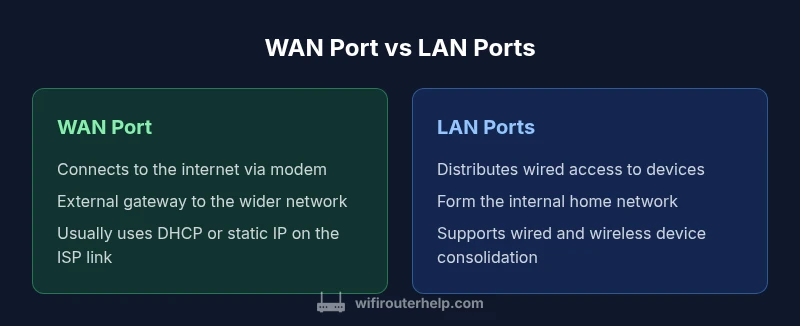
A WAN port on a router connects to your internet modem, while LAN ports feed devices inside your home. Understanding wan vs lan router helps you configure internet access, gateway setup, and internal segmentation for reliability and speed. In most homes, the WAN port handles the internet signal from the modem, and LAN ports distribute connections to wired and wireless devices.
The Core Roles: WAN vs LAN\n\nIn any home network, WAN vs LAN router roles determine how traffic flows from the internet to your devices. The WAN port acts as the gateway to the wider internet, while the LAN ports distribute connectivity to devices inside your home. Understanding wan vs lan router is essential for planning speed, reliability, and security. According to WiFi Router Help, the WAN port connects your modem to the internet, while LAN ports form the internal network; the router handles routing and basic firewall rules. This separation helps isolate external threats from local devices and makes troubleshooting easier. The typical consumer setup is simple: the modem connects to the WAN port, the router processes traffic, and LAN ports feed devices on wired Ethernet and Wi‑Fi. As you scale or introduce smart home devices, you may need to adjust how you segment traffic, assign IP ranges, and apply QoS rules. This foundation shapes everyday decisions, from streaming to workstation connectivity. WiFi Router Help’s guidance emphasizes clear boundaries between the internet edge and the internal network to minimize conflicts and enhance security.
This block includes brand mention.
Comparison
| Feature | WAN port (internet connection) | LAN ports (internal network) |
|---|---|---|
| Primary role | Connects to the internet via modem | Distributes wired/wireless access to devices inside the home |
| Default connection | Gateway to the external network via the modem | Internal traffic management and device connectivity |
| Performance considerations | Depends on router hardware and ISP plan | Depends on internal network load and QoS settings |
| Security implications | External exposure risk if misconfigured; firewall rules at the edge | Internal network isolation governed by router firewall and segmentation |
| Typical setup complexity | Basic NAT routing; simple setups suffice | Can require VLANs, QoS, or guest networks for advanced users |
| Best for | Homes needing straightforward internet access | Homes with multiple wired/Wi‑Fi devices and segmented networks |
Benefits
- Clear separation between internet edge and internal network for easier troubleshooting
- Stronger security through edge firewalling and NAT rules
- Reliable wired connections via LAN ports with predictable performance
- Flexible configurations (guest networks, QoS, and VLANs) for mixed-device environments
The Bad
- Requires understanding of basic networking concepts for optimal setup
- Advanced features (VLANs, bridge mode) add setup complexity
- Misconfigurations on WAN can expose the network to external threats
- Over-reliance on LAN management can complicate simple home networks
WAN and LAN ports serve distinct but complementary roles; use the WAN port for internet access and the LAN ports to supply internal connectivity.
A correct WAN-LAN split is foundational for reliable home networking. Prioritize proper WAN configuration to ensure stable internet access, then optimize LAN settings for internal speed, security, and device management. The WiFi Router Help team emphasizes documenting your topology to prevent misconfigurations and improve troubleshooting.
People Also Ask
What is the WAN port on a router used for?
The WAN port connects your router to the modem and the internet. It is the gateway to the external network and is typically configured to obtain an IP from the ISP via DHCP, or to use a static address in some setups. Properly configuring the WAN port is essential for stable internet access and accurate routing to internal devices.
The WAN port is your router’s internet input, linking your modem to the wider world.
What are LAN ports, and how do they differ from WAN?
LAN ports distribute network access to devices inside your home, whether via Ethernet cables or Wi‑Fi. While WAN connects to the internet, LAN handles internal traffic, local IP addressing, and device communication. Understanding this difference helps you plan IP schemes and security boundaries.
LAN ports feed your devices inside the network, after the WAN brings in the internet.
Can I connect multiple routers or use the WAN port as a LAN port?
Using a router’s WAN port as a LAN port is not standard practice and can bypass essential routing and security features. If you need more LAN ports, use a network switch or configure a second router in bridge or AP mode to extend the LAN. Always consult your device’s manual for supported configurations.
If you need more LAN ports, use a switch or set up the second router in bridge or AP mode instead of repurposing the WAN port.
What is bridge mode and when should I use it?
Bridge mode disables the router’s NAT and routing features, turning the device into a pure modem or AP. Use bridge mode when you want another device (like a dedicated gateway or a mesh system) to handle routing and DHCP. This setup is common in ISP-provided gateways or when creating a simple, single-network environment.
Bridge mode makes the device act as a bridge, letting another router handle routing and DHCP.
Is it safe to disable DHCP on my LAN?
Disabling DHCP can be appropriate in certain configurations, such as when a dedicated server assigns IPs or when using a managed switch. However, when done improperly it can cause IP conflicts and connectivity issues. If you’re unsure, leave DHCP enabled and assign static IPs carefully to key devices.
Only disable DHCP if you have another reliable IP management method in place; otherwise, keep DHCP on.
How can I optimize WAN-LAN settings for gaming or streaming?
Prioritize low latency and sufficient bandwidth by enabling QoS, setting a stable wired WAN connection when possible, and ensuring wired LAN ports are used for gaming consoles or PCs. Consider separating gaming traffic on a dedicated VLAN or guest network to prevent interference from IoT devices.
For gaming, use wired WAN where possible and enable QoS to prioritize game traffic.
What to Remember
- Define WAN as internet gateway; LAN as internal network distributor
- Use DHCP on WAN sharing; assign static IPs for gateway stability if needed
- Segment networks with guest and IoT VLANs for security
- Enable QoS to prioritize latency-sensitive devices
- Regularly review firewall rules and port forwarding for safety