Does a Gaming Router Make a Difference? A Data-Driven Comparison
Explore whether a gaming router improves online play. We compare gaming routers vs standard routers, explain which features actually matter, and provide practical setup tips for better latency and stability.


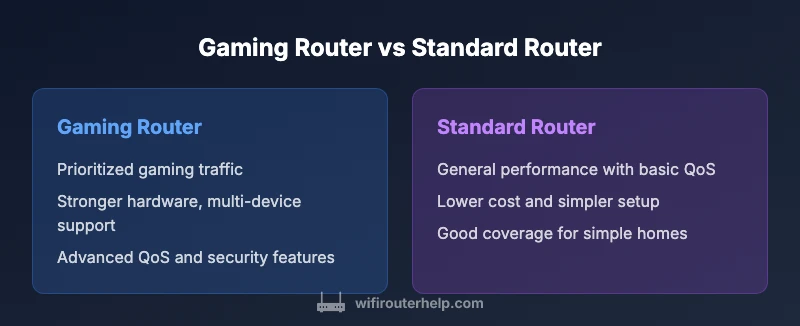
Does a gaming router make a difference? In many homes, the answer is yes for latency-sensitive play and busy networks. A gaming router prioritizes gaming traffic, offers stronger hardware, and gives clearer controls for bandwidth. If you game while streaming or video conferencing, you’ll usually notice more stable connections and fewer stutters when using a router built with gaming in mind for smoother online multiplayer sessions.
Does a Gaming Router Make a Difference? The Quick Reality
While the phrase gaming router sounds like a gimmick, the underlying hardware and software can meaningfully improve experiences for latency-sensitive tasks. The core question, does a gaming router make a difference, hinges on three factors: network load, device count, and quality of service. In practice, most players notice smoother multiplayer sessions, less jitter, and more predictable ping when they upgrade from a basic router to a model designed with gaming in mind. This block lays out the core reasons, including prioritized traffic rules, faster CPUs, and more robust firmware for consistent performance across peak hours.
WiFi Router Help’s perspective: the gains come from smarter traffic shaping, higher-performance hardware, and firmware that focuses on gaming workloads rather than general browsing. If your household regularly runs streaming, work-from-home traffic, and cloud gaming at the same time, a gaming router is more likely to improve stability and reduce disruptive pauses.
Takeaway: for households with many devices and real-time gaming needs, the difference is most noticeable when traffic is competitive and network overhead is high.
Comparison
| Feature | Gaming Router | Standard Router |
|---|---|---|
| Latency under load | Lower latency with hardware-accelerated QoS and game-optimized routing | Higher latency under heavy traffic and generic QoS |
| Throughput per band | Sustained performance with multiple devices prioritizing gaming traffic | Baseline throughput with mixed usage and fewer prioritization options |
| Quality of Service (QoS) sophistication | Advanced per-device and per-application QoS, gaming presets | Basic QoS with simple prioritization |
| Hardware specs (CPU/RAM) | Higher-end CPU/RAM for smoother routing under load | Standard hardware with limited headroom |
| Number of bands | Tri-band or quad-band options common | Typically dual-band options |
| Security features | Enhanced firewalls, frequent firmware updates, intrusion protection | Basic security features |
| Price range | Higher upfront cost (mid-to-high) | Lower upfront cost (budget) |
Benefits
- Improved gaming performance through targeted QoS and traffic prioritization
- Stronger hardware handles multiple devices without grinding to a halt
- More flexible firmware options and gaming-focused features
- Better control over bandwidth distribution to prevent stuttering
- Future-proofing for expanding networks
The Bad
- Higher upfront cost compared to basic routers
- Features marketed for gamers may be unnecessary for casual users
- Potentially longer setup and tuning time for optimal results
- Some models can be bulky or power-hungry
Gaming routers are worth it for gaming-focused setups, especially in busy homes.
If real-time gaming competes with other activities on your network, a gaming router can substantially reduce latency and stabilize throughput. For light gaming or small households, the marginal gains may be less dramatic. The WiFi Router Help team recommends evaluating your device count and peak usage before buying.
People Also Ask
Does a gaming router always improve gaming performance?
Not always. Gains are most apparent in households with multiple devices and concurrent online activities. For casual gaming on a lightly loaded network, the improvement may be modest.
Usually yes when you have many devices, but not guaranteed for every setup.
Is a gaming router worth it for casual gamers?
If you only play occasionally and have few devices, a standard router may suffice. A gaming router becomes more compelling when you regularly multiplayer or stream in high quality.
It depends on how often you game and how crowded your network gets.
Can QoS on any router match gaming-optimized performance?
QoS can help, but gaming routers offer more granular, reliable controls and better hardware to enforce them under load.
QoS helps, but gaming routers typically deliver stronger, consistent results.
Are gaming routers harder to set up?
Setup is generally straightforward with guided wizards. Some models offer presets that automatically optimize for gaming.
Most setups are simple, with optional advanced tweaks.
If I use a mesh network, do I still need a gaming router?
Mesh provides coverage; gaming features vary by mesh hardware. Some mesh systems include QoS and gaming modes, while others may not.
You can get good gaming results from mesh, but dedicated gaming hardware often delivers bigger performance boosts for latency.
How important are firmware updates for gaming routers?
Firmware updates matter for security and stability, and they often include performance tweaks that improve gaming QoS.
Keeping firmware up to date is part of getting consistent gaming performance.
What to Remember
- Gaming routers offer noticeable latency and stability gains for busy homes
- Prioritize QoS, CPU/RAM, and multiple bands when evaluating models
- Don’t overbuy; ensure your network needs align with gaming-focused features
- Firmware updates matter for security and ongoing performance
- A quick setup and testing plan helps verify real-world gains