How Big Should a Router Table Be? A Practical Guide
Learn how to pick the right router table size for your workshop. This guide covers width, depth, height, and ergonomic considerations, with practical sizing ranges and setup tips for hobbyists and serious woodworkers.


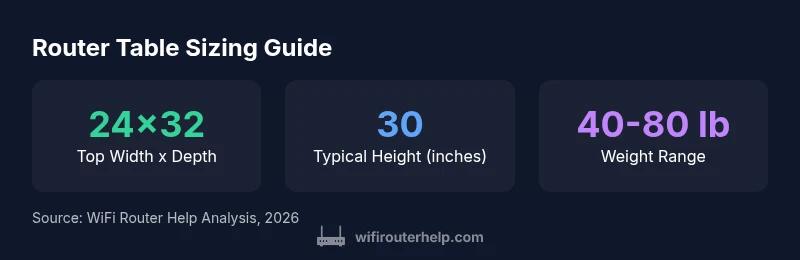
How big should a router table be? The ideal size depends on space and the projects you tackle. For most hobbyists and light shop use, a top around 24x32 to 24x36 inches offers stable support while leaving room for dust collection and movement. In tighter spaces, an 18x24 inch top can work, while larger setups can use 28x36 inches or bigger for extra work surface.
Understanding how big should a router table be
For many woodworkers, the question how big should a router table be is about balancing space and capability. The size you choose affects stability, vibration control, and how comfortably you can handle long pieces or complex bit profiles. In practice, you want a top that supports a comfortable stance, allows you to feed workpieces without binding, and leaves room for dust collection and under-table storage. A well-sized router table also accommodates the fence, lift, and insert plate without crowding the work area. When you start with a clear picture of your typical projects—small edge profiles or large mortises—the decision on size becomes more concrete. The takeaway is to tie size to function, not aesthetics or whimsy.
A practical mindset is to map your workflow: how often you flip pieces end-for-end, how long your longest cuts are, and whether you frequently work with unusually tall stock. If your shop has a fixed footprint, you may need to prioritize depth over width to keep your router’s lifting mechanism and fences accessible. In other words, size should enable, not hinder, your most common operations. The right router table size is the one that fits your throughput, minimizes vibration, and leaves space for safe, precise milling.
Key dimensions: width, depth, and height
The core measurements for a router table are width (the left-to-right span), depth (the front-to-back reach), and height (how high the table sits relative to your stance). For many hobbyists, width is in the 24- to 36-inch range, while depth often lands between 18 and 28 inches. These ranges strike a balance between stability and maneuverability. If you frequently work with long boards or panels, a wider top—closer to 36 inches—helps guide stock smoothly. For compact spaces, an 18x24 inch top can work, but expect more frequent repositioning.
Height is equally important: aim for a practical ergonomic setup where your elbows rest comfortably at about waist level when guiding stock. A typical target is 30 to 34 inches, though tall or short users may prefer ±2 inches. Remember that this is not a rigid specification; you can adjust by choosing a table with adjustable legs or a stand that allows fine-tuning. Finally, consider the under-table footprint: a taller, narrower cabinet can save floor space, while a broader base improves stability during heavy cuts.
Measuring your space and planning around your router
Before committing to a size, take precise measurements of your workshop. Measure doorways for passage, ceiling clearance for dust-collection hoses, and the available wall length for fence and extension. A simple planning exercise is to sketch three layouts: a compact 18x24 inch top setup, a mid-range 24x32 inch footprint, and a larger 28x36 inch configuration. Compare how much room each demands for feed-through, clamps, and accessories. You should also account for future purchases, such as a heavier lift mechanism or additional fence segments.
A reliable rule of thumb is to add two feet of working space around the table where possible. This elbow room helps prevent accidental contact with spinning bits and provides space for waste collection and tool stowage. If you anticipate frequent material handling from all sides, a larger top with a symmetric footprint can improve visibility and safety. In short, measure twice, plan for the expected workflow, and choose a size that minimizes compromises.
Features and their footprint: understanding interaction with size
Router tables are not just tops; the footprint expands with the fence length, lift, insert plate, and dust-collection ports. A longer fence requires more lateral room on the table, which in turn affects the usable width. If your budget allows, consider a top width that accommodates at least 36 inches of fence travel, which offers better support for long stock. Depth interacts with the location of the router insert; deeper tops can accommodate larger insert plates and more internal routing depth. Ergonomics matter, too: adjustability in height or tilt can offset a non-ideal top size. When sizing, prioritize the combined footprint of the top, fence, lift, and dust-collection hose routing. A well-planned footprint reduces the risk of collision with tools or clamps and improves overall workflow.
Budget, materials, and long-term value
Router tables come in a range of materials—from plywood and MDF to cast iron and aluminum tops. Heavier tops (like cast iron) offer superior vibration damping and durability but at a higher price and heavier handling requirements. Mid-range options (solid wood or MDF with a high-density core) balance cost and performance. If you anticipate moving the table or reconfiguring your shop, a modular system with a lighter top might be advantageous, even if it sacrifices some rigidity. When evaluating size, balance the initial investment with long-term value: a larger table that enables more tasks may save money in upgrades later on. In all cases, ensure the insert plate sits flush and the fence rails are stable to maximize repeatability and cut quality.
Space optimization for small shops: a practical approach
Small shops demand smart sizing. In tight spaces, consider a 18x24 inch top to free floor space for a drill press or a workbench. If you use a router table regularly but lack room, a 24x32 inch top paired with a compact, wall-mounted dust collection system can deliver excellent results without sacrificing safety. When you do have space for a larger table, a 28x36 inch top provides substantial work surface for long boards and multiple pass setups. Remember, the key is to prioritize stability and control: a slightly larger top that stays rock-solid will yield better results than a larger but wobbly surface. Finally, plan your layout to allow for clear access to power outlets and dust collection ports, which significantly affects your day-to-day efficiency.
Router table size considerations
| Dimension | Recommended Range | Notes |
|---|---|---|
| Top width | 24-36 inches | Stability across longer workpieces |
| Top depth | 18-28 inches | Room for fence and insert |
| Table height | 30-34 inches | Ergonomic for typical seated/standing work |
| Weight range | 40-80 pounds | Material dependent |
People Also Ask
What is the most common router table size for hobbyists?
For hobbyists, a 24x32 to 24x36 inch top is typical. It provides solid support for standard routing tasks while leaving room for fences and dust collection. If space is extremely tight, an 18x24 inch top can work, but expect a tighter workflow.
Most hobbyists use a 24 by 32 inch to 24 by 36 inch router table top; smaller spaces can use 18 by 24, but that limits longer cuts.
Should I prefer fixed-height or adjustable-height for size purposes?
Size considerations apply to both fixed and adjustable tables. Choose based on your ergonomics and lift mechanism. Adjustable height helps when you switch between different tasks, but the overall footprint remains similar.
Whether fixed or adjustable, pick a size that fits your space and feels comfortable.
How does table size affect project accuracy?
A larger top typically offers better support for long stock and can reduce deflection. However, accuracy also depends on the table’s rigidity, fence quality, and insert alignment. The goal is a stable, square setup that minimizes wobble during passes.
Larger tops can improve accuracy if they stay rigid; the fence and inserts matter too.
What are typical dimensions for compact workshops?
In tight spaces, 18x24 inches tops are common, with 24x32 inches offering a good balance when space allows. Expect more frequent repositioning with the smaller option but a taller space may still be usable with proper setup.
For small spaces, 18 by 24 inch tops are common, but 24 by 32 inches is a solid middle ground.
What other dimensions matter besides width and depth?
Height, fence length, and insert opening size all influence usability. Ergonomics around 30-34 inches high are typical, with a fence that offers at least 36 inches of travel for flexibility.
Consider height for comfort, and ensure your fence and insert fit your workflow.
How should I budget for a router table size upgrade?
Budget for a stable, well-supported top first. Subtle gains in rigidity from heavier tops pay off with better finish quality. Plan for future add-ons like a better fence, lift, and dust collection if your projects grow.
Invest in stability first; upgrade fences and dust collection as needed.
“Choosing the right router table size comes down to space, project scope, and safe handling. A well-sized top reduces vibration and improves accuracy.”
What to Remember
- Measure workspace before choosing size
- Aim for stability with room for dust collection
- Balance top size with fence and insert footprint
- Ergonomics: target 30-34 inches height
- Larger tops help long-piece accuracy when paired with a solid fence