CNC Router for Beginners: A Practical Starter Guide
A comprehensive how-to guide for starting with a CNC router. Learn safety, setup, CAD/CAM workflows, and your first project with clear, beginner-friendly steps.


Begin your cnc router journey with a straightforward, beginner-friendly plan. This guide covers safety, hardware basics, and a practical CAD-to-CAM workflow for your first project. By following a clear, step-by-step approach, you’ll design, generate toolpaths, and run your first cut with confidence. According to WiFi Router Help, planning saves time and reduces mistakes in any home workshop. Start small, learn by doing, and scale up as you gain experience.
What is a cnc router for beginners and who should use one
A CNC router is a computer-controlled cutting machine that uses spinning bits to shape wood, plastic, foam, or soft metals with high repeatability. For a cnc router for beginners, the goal is to learn the basics of setup, safety, software, and simple projects without overwhelming complexity. In many home workshops, a benchtop or compact router offers a practical path to prototyping and customizing projects. As you begin, remember that successful results come from clear planning, accurate zeroing, and conservative test runs. The more you practice fundamental steps, the faster you’ll progress. This guide emphasizes bite-sized learning, repeatable workflows, and safe operation, so you can stay productive while minimizing risk.
Core components you’ll interact with
A CNC router consists of several core parts that you’ll become familiar with as you practice. The gantry carries the spindle, which holds the cutting bit. The drive system (usually a pair of precision ballscrews or belt drives) moves the gantry along the X, Y axes, while a separate Z-axis operator controls depth. A control board or separate computer runs the machine’s firmware and interprets G-code, the language that tells the router where and how to cut. You’ll also encounter a spoilboard or wasteboard on top of the machine bed to support clamps and protect the table, plus dust collection to keep your workspace clean. Understanding these components helps with maintenance, troubleshooting, and choosing the right entry-level model for your space.
Safety first: PPE and shop setup
Safety should always come first when working with a CNC router for beginners. Wear eye protection, hearing protection, and a dust mask or respirator when cutting. Keep a fire extinguisher accessible and maintain clear walkways around your workshop. Secure your workpiece with clamps or a vacuum table to prevent movement during cutting. Ensure your machine is unplugged while changing bits and that you understand spindle rotation direction. Finally, keep long hair and loose clothing away from moving parts. A tidy, well-organized workspace reduces accidents and speeds up learning.
Setting up your first CNC router: space, power, and wasteboard
Choose a sturdy, level workspace with enough room for the machine and material. Provide adequate power supply and outlet access near the router and use surge protection if possible. Install a spoilboard on the router bed to absorb clamping pressure and reduce the chance of damage to the work surface. If you’re new to dust control, consider a basic dust collector or shop vac connected to a simple ducting system. Measure and plan stock sizes before mounting, and lay out a safe, repeatable clamping plan for your typical projects to minimize remakes.
Software basics: CAD/CAM to G-code
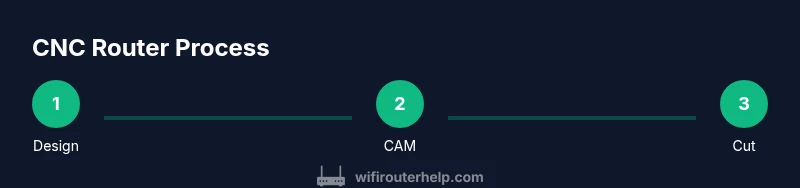
Turn your idea into a digital design with CAD software, then generate toolpaths using CAM software. The CAM step translates the design into G-code, which instructs the router how to move, at what speed, and with which depth of cut. Start with simple shapes and a pocket or profile cut before attempting complex 3D carvings. When choosing software, look for beginner-friendly interfaces, robust community tutorials, and the ability to export standard G-code. Practice by generating toolpaths for small test pieces and review the resulting code before cutting.
Choosing your first project and materials
Begin with forgiving materials like plywood or lightweight foam. A simple project such as a wooden coaster, sign, or small tray helps you focus on technique rather than material idiosyncrasies. Select bits that are appropriate for the material and project: a sharp upcut end mill for planking, a downcut bit for clean edge finishes on certain materials, and a small-diameter bit for fine details. Plan a project with straight lines and shallow depths to minimize tool wear and maximize your success rate as a beginner.
Running your first cut: setup, zeroing, and test runs
Before cutting, confirm your stock dimensions, zero the machine at the corner of the workpiece, and verify all security measures. Do a dry run (without spinning the bit) to confirm toolpath routing and detect potential collisions. Once you’re confident, run a light cut at a conservative feed rate to observe how the machine behaves and whether the part moves or chatter occurs. If everything looks good, run the final cut with appropriate clearance and dust collection enabled. Stay nearby to pause the job if anything looks off.
Common issues and troubleshooting
If you see chatter, your feed rate or spindle speed may be off for the material. Z-zeroing mistakes can cause partial depths or touches; re-zero if needed and re-check the workpiece surface. Poor edge quality can indicate dull bits or insufficient clamping. If the machine stalls or skips steps, verify belt tension, stepper drivers, and power supply stability. For persistent problems, simplify your toolpath, test on scrap stock, and review machine alignment and calibration. Patience and incremental steps are key to reliable results.
Maintenance and ongoing improvements
Regular maintenance keeps your CNC router performing well. Lubricate moving joints according to your machine’s manual, check belt tensions, and inspect bit quality before every run. After completing projects, clean the spoilboard, check the calibration, and document any adjustments for future reference. As your skills grow, you’ll experiment with more advanced toolpaths, different materials, and larger projects. Keep a project log and gradually increase complexity to build confidence.
Tools & Materials
- CNC router (benchtop or mid-size)(Ensure alignment, speed range, and safety features fit beginners' needs)
- Stock materials(Start with plywood or lightweight foam (1/4" to 1/2" thick))
- Clamps or vacuum table(Secure workpiece firmly to the spoilboard)
- Wasteboard/spoilboard(Absorbs clamps and protects the bed)
- CAD/CAM software(Free or paid options; ensure it can export G-code)
- Cutting bits (end mills)(Include 1/8" and 1/4" sizes; sharp and appropriate for material)
- Zeroing tools(Edge finder or touch plate helps accurate Z-zeroing)
- Measuring tools(Calipers and a square for precise setup)
- Dust collection(Helps keep the workspace clean and safe)
- Safety gear(Safety glasses, hearing protection, and a mask or respirator)
- Power strip/surge protection(Protect electronics and machine from surges)
Steps
Estimated time: 2-3 hours
- 1
Unbox and inspect the machine
Carefully unpack the CNC router, verify all parts are present, and read the basic safety instructions. Check for obvious damage and ensure the spindle can rotate freely by hand. This initial check reduces surprises during the first feed runs.
Tip: Take photos of all components and note missing items for the supplier. - 2
Mount a spoilboard and secure the workpiece
Attach a spoilboard to the router bed and plan a simple clamping grid. Use clamps or a vacuum setup to hold the test piece firmly, preventing movement during cutting. A stable setup minimizes chatter and improves accuracy.
Tip: Mark reference edges on the spoilboard to help repeatability. - 3
Install software and connect the controller
Install a beginner-friendly CAD/CAM package and connect it to the router’s controller or the computer that drives the machine. Confirm that the software can export G-code and that the controller recognizes the machine.
Tip: Use a test project from the software library to verify basic operation. - 4
Calibrate zero and home positions
Zero the X, Y, and Z axes at the workpiece corner or center, depending on your workflow. Accuracy at the zero point impacts every cut, so double-check the reference surface and tool height.
Tip: Record the zero coordinates for future projects to speed up setup. - 5
Generate a simple toolpath
Create a basic pocket or outline toolpath for scrap stock to test the system. Review feed rate and spindle speed assumptions, ensuring the cut depth is shallow for the first pass.
Tip: Run a simulation within the CAM software to catch obvious collisions. - 6
Perform a dry run
With the spindle stopped, simulate the toolpath to ensure there are no unexpected machine moves. This catch helps avoid costly mistakes before the initial cut.
Tip: Ensure safety gear is worn during the dry run since occasional tool movement can still occur. - 7
Run a light first cut
Make a shallow cut on scrap material to validate behavior. Observe noise, vibration, and edge quality to determine if adjustments are needed.
Tip: If you see excessive vibration, slow the feed rate and verify belt tension. - 8
Proceed to a full cut on your first project
With confidence from the test run, execute the full depth cut on your chosen project material. Monitor temperature, smoke, and cut quality; pause if anything looks abnormal.
Tip: Have a plan for fast stopping and a safe shutdown in case of issues. - 9
Inspect, finish, and log results
After cutting, inspect the part for fit and finish. Deburr edges and dry-fit with other components if applicable. Record what worked and what didn’t to inform future projects.
Tip: Note any tool changes or material adjustments for next time.
People Also Ask
What safety gear should I wear when starting with a CNC router?
Always wear eye protection, hearing protection, and a respiratory mask or dust mask. Keep a fire extinguisher nearby and ensure good ventilation in your workspace.
Wear eye and hearing protection, plus a dust mask; keep a fire extinguisher handy and work in a well-ventilated area.
Can I use free software for CAD/CAM on a beginner CNC router?
Yes. There are beginner-friendly, free CAD/CAM options that export standard G-code. Start with a basic package to learn the workflow and upgrade later if needed.
Yes. Start with a free CAD/CAM option to learn the workflow before investing in paid software.
What stock material is best for my first project?
Plywood or foam is forgiving for beginners. Avoid hardwoods until you’re comfortable with feeds, speeds, and tool wear.
Begin with plywood or foam to learn toolpath basics and gradually move to hardwoods.
How do I know if my zeroing is accurate?
Test by running a small cut at the corner and verifying the depth. If cuts go past the edge, re-zero and re-measure.
Test a small cut to confirm placement, then re-zero if needed.
What’s the most common issue beginners face with a CNC router?
Chatter and imprecise cuts from incorrect feed rates or dull bits. Start with conservative speeds and sharpen or replace bits as needed.
Chatter often comes from wrong feed rates or dull bits; adjust speeds and replace bits if needed.
Watch Video
What to Remember
- Plan first, then cut with measured steps
- Secure the stock to prevent movement
- Calibrate zero points accurately for consistent results
- Dry run and test cuts save material and time
- Maintain a log of settings and outcomes for progress